
6 min read
European Airlines Industry Outlook: Demand Resilient but Middle East Disruptions Weigh on Operations
European airlines experienced strong demand and constrained capacity, while Middle East disruptions weighed on fuel costs, efficiency, and operations. Here’s what you should know.

In the second quarter of 2026, network carriers benefited from redirected traffic, resilient premium demand, improving North Atlantic dynamics, and capacity discipline, while low-cost carriers continued to face investor concerns around fleet availability, fuel costs, and execution risk.
Strong demand and constrained capacity continue to support load factors, while airlines remain focused on pricing discipline, profitability, and network optimization.
The European Airlines: Q2 2026 Industry Pulse breaks down the trends advisors should watch, including pressures on fuel cost and efficiency. Download the free report for the full analysis.
Operational Costs and Capacity Challenges
Unit Costs to Ease Midterm
We expect unit costs to ease in the midterm, yet they will remain structurally above 2019 levels though 2029 as airport and air traffic control charges persist. Labor inflation, airport fees, air traffic control charges, and maintenance bottlenecks continue to pressure costs.
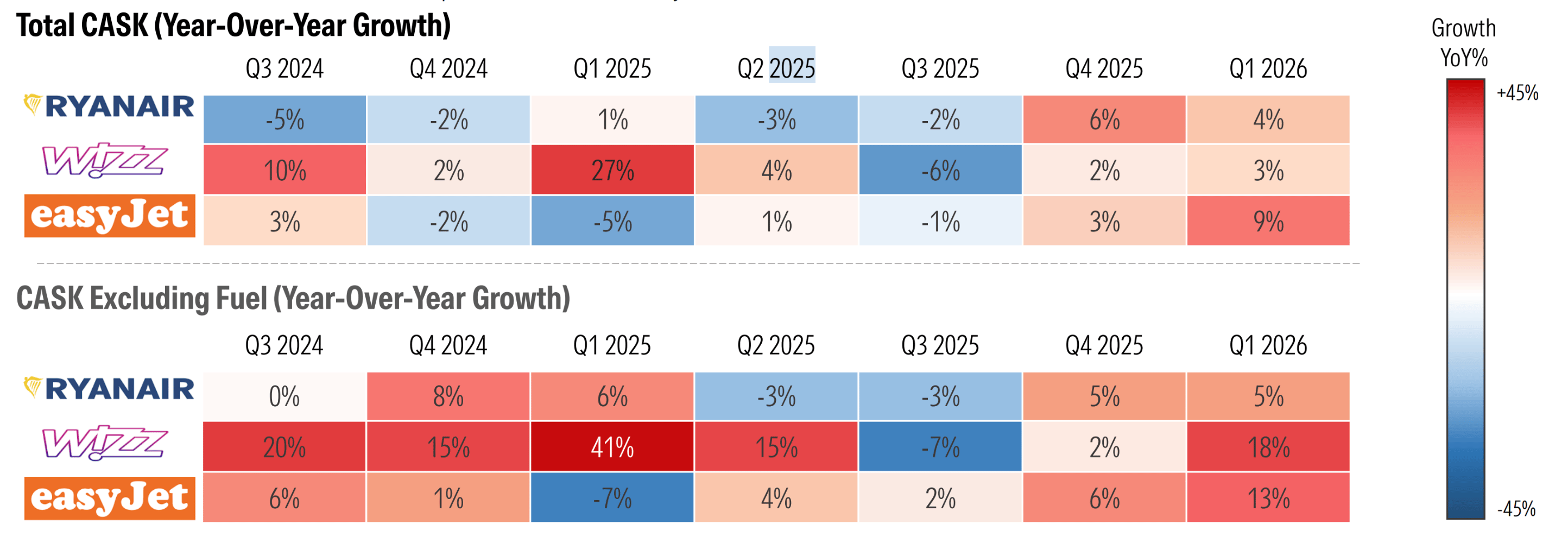
Source: Company reports, Morningstar analysis. Assessment covers full company cost structure, beyond the passenger airline business. Results are shown in calendar-year quarters. Airlines with noncalendar fiscal years have been realigned for comparability. Full-year expectations based on airline reporting. LCC stands for low-cost carriers. ATC: Air traffic control
We expect further easing as new-generation aircraft enter service, although fuel volatility, airport charges, and ATC costs are likely to keep unit costs above prepandemic levels. Deliveries of the Airbus A321neo and Boeing Max will reduce wet-lease dependence, boost seat density, and lower fuel-burn and maintenance costs.
Capacity Growth Hits Structural Limits
Fleet shortages, operational disruptions, and Middle East conflict-related constraints continue to restrict Europe-linked capacity growth.
European Airlines Kept Capacity Tight Amid Geopolitical Shifts and Rising Costs
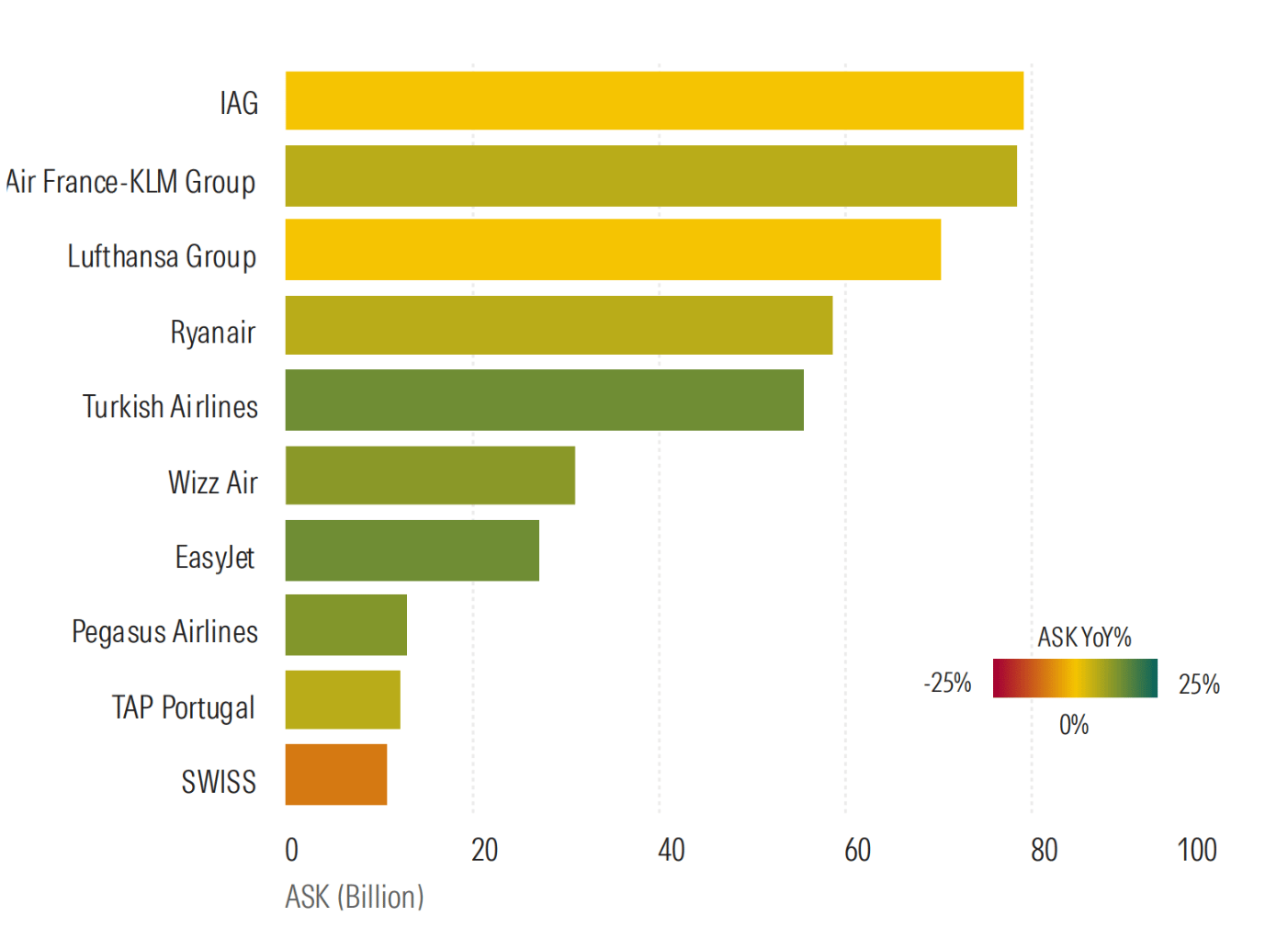
Sources: IATA; Morningstar analysis. RPK stands for revenue passenger kilometer and is a measure of demand; ASK stands for available seat kilometer and is a measure of capacity. Results are shown in calendar-year quarters. Airlines with noncalendar fiscal years have been realigned for comparability
These constraints are reshaping competitive dynamics. Airlines focused available capacity on the strongest long-haul markets while prioritizing yields and profitability over volume growth.
These dynamics increasingly reward airlines that can optimize network deployment, maintain pricing discipline, and manage costs effectively amid ongoing capacity constraints.
How Will Middle East Disruptions and Market Shifts Impact European Airlines?
Cost inflation has moderated in some areas, but rising fuel prices and operational disruptions remain important near-term risks.
In the near term, Middle East disruptions are weighing heavily on short-term fuel costs and operational efficiency, threatening to reverse previous fuel tailwinds.
Middle East airspace disruptions have primarily created operational inefficiencies rather than structural demand destruction. Rerouting increases fuel burn, flight times, and utilization pressure, while weaker Gulf hub connectivity supports European network carrier yields and load factors on selected long-haul routes.
Traffic diverted from disrupted Gulf hubs, which account for more than 25% of Europe-Asia flows, benefited European network carriers.
Advisors should assess investments carefully, focusing on carriers with adaptable strategies and efficient cost management to mitigate potential risks. In the near term, this means favoring carriers that can better absorb fuel price shocks from Middle East disruptions. For the long term, that means focusing on airlines best positioned to manage structurally higher airport and air traffic control fees.
Passenger Demand and Fare Trends
Europe's Air Travel Demand Remained Strong Despite Disruptions and Economic Uncertainty
Premium demand remains resilient, supporting long-haul yields for network carriers, while industry-wide capacity constraints continue to support pricing.
Europe-linked demand growth reached 6% year over year, while capacity growth was 3.3%, supporting elevated load factors.Low-cost carriers also reported robust demand, though booking windows shortened amid uncertainty around regional stability. With more bookings converting closer to departure, airlines discounted earlier to secure most of the load factor in advance, putting pressure on fares.
Europe-Linked Demand Growth Reached 6% Despite Disruptions
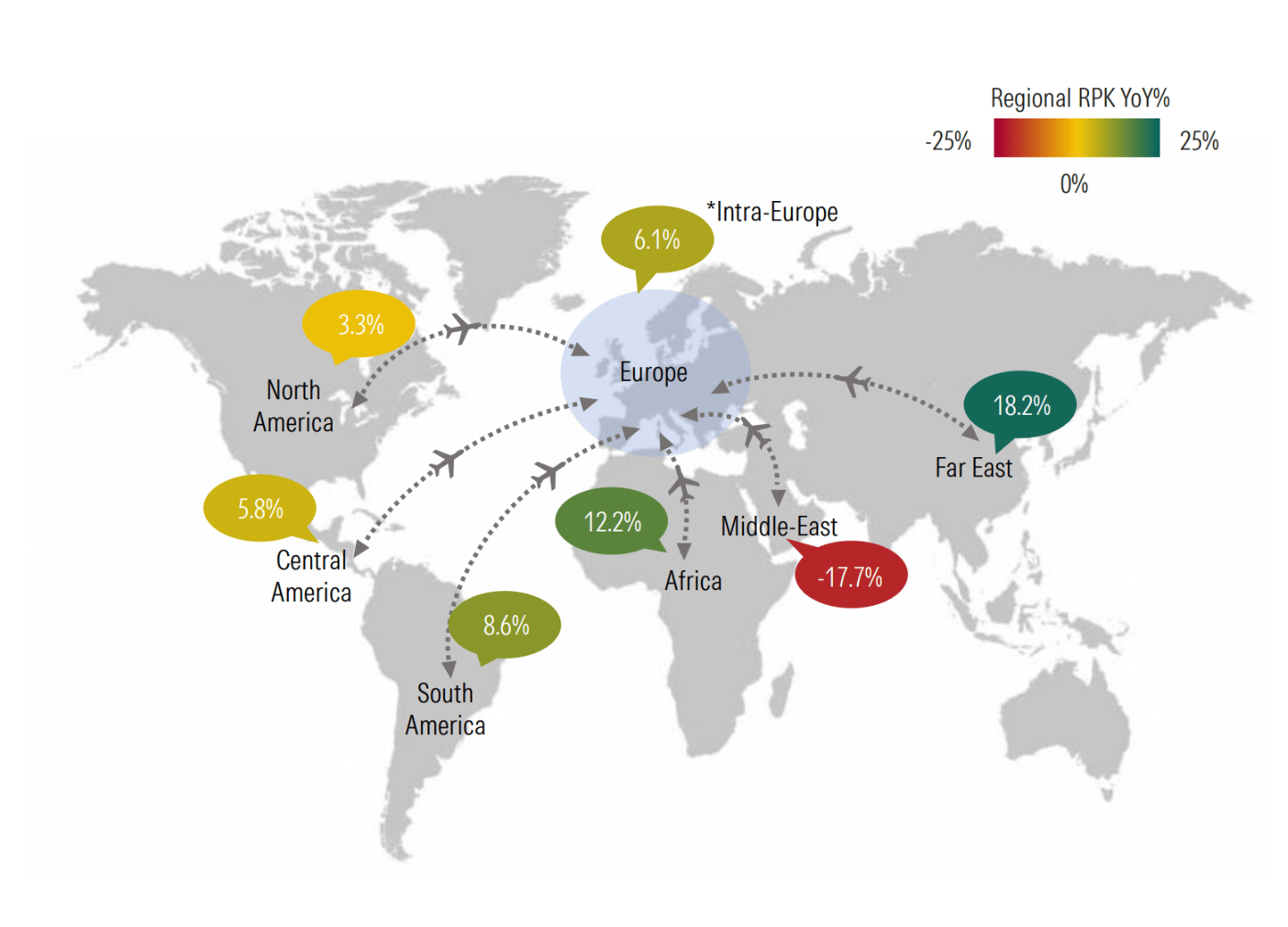
Sources: IATA; Morningstar analysis. RPK stands for revenue passenger kilometer and is a measure of demand; ASK stands for available seat kilometer and is a measure of capacity. Results are shown in calendar-year quarters. Airlines with noncalendar fiscal years have been realigned for comparability
Why Pricing Power Remains Resilient Amid Softer Demand
Strong demand and constrained capacity continue to support pricing. Revenue yields remain above 2019 levels and are supported by premium demand, industry cost inflation, and capacity constraints.
We expect yields to moderate gradually as supply increases but remain above 2019 levels.
Load factors remained high across most routes, reflecting resilient demand and industrywide capacity constraints.
This indicates that pricing is being sustained by a combination of supply constraints and improved revenue mix, with airlines prioritizing higher-yield traffic. As a result, pricing power remains a more important driver of performance than volume growth.
Finding Fair Value in a Mature and Disrupted Market
Valuations have largely converged toward Morningstar fair value estimates. Most carriers trade near fair value as supportive industry fundamentals are balanced against geopolitical and cost uncertainties.
We assign no economic moat to European airlines, citing intense price-based competition, limited switching costs, and exposure to cyclical and regulatory shocks. In that context, fair valuation is the norm rather than the exception.
European Airline Coverage
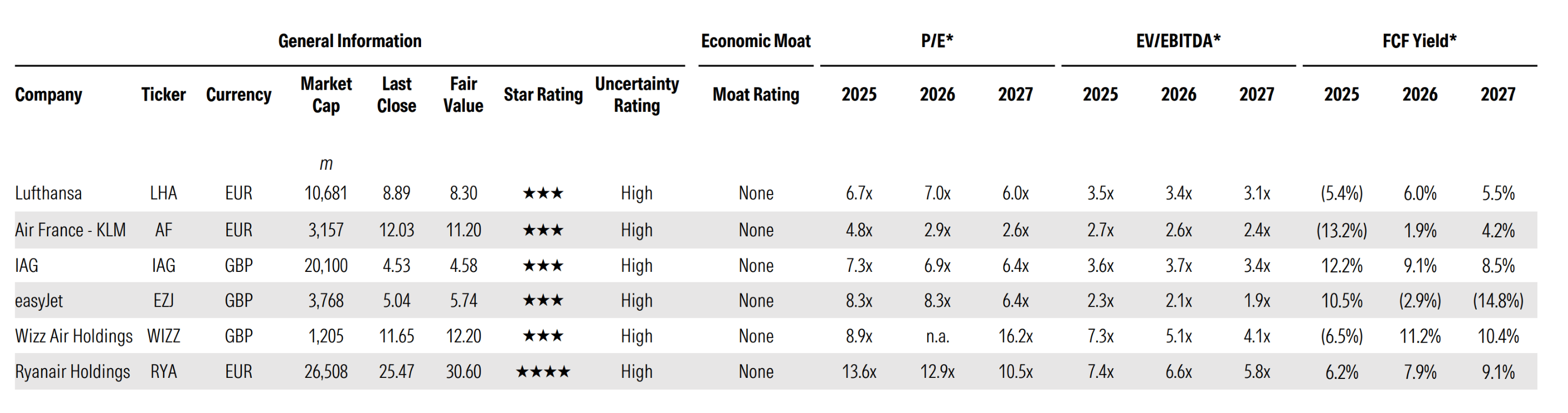
Source: PitchBook. Data as of June 17, 2026. *Based on FactSet consensus.
Top Airline Picks: Ryanair and EasyJet Offer the Best Mix of Valuation Upside and Resilience
Morningstar's top picks are Ryanair and easyJet.
Wizz Air is the most exposed, with lower hedge coverage, higher fuel intensity, and less earnings resilience.
Ryanair remains the highest-quality operator in the group and is trading at the largest discount to Morningstar’s fair value estimate. EasyJet has no direct Middle East exposure and remains supported by its focus on primary airports, fleet modernization, and the growth of its holidays business.
Replacing older aircraft with larger, more fuel-efficient models allows airlines to improve slot productivity, lower unit costs, and deploy capacity in higher-return markets.
What Should Advisors Watch Next?
European air travel remains a market shaped by constrained capacity, selective growth, and execution risk.
Middle East disruptions remain the principal near-term risk because they increase fuel costs and operational inefficiencies, but they have not led to structural demand destruction.
Key variables to monitor include fuel costs, capacity deployment, pricing discipline, and the pace at which operational constraints ease. With most stocks trading near fair value, opportunities are likely to be concentrated in companies facing temporary disruptions rather than structural disadvantages.
Advisors should monitor fuel volatility, airport fee structures, and capacity deployment as the primary indicators of future profitability.
For further insights into the long-term trends, competitive advantages, and potential risks shaping the wider sector, explore our comprehensive Airline Industry Analysis.