
27 min read
Australian and Global Market Outlook 2027
From expectations around artificial intelligence to the case for Australian small and mid-caps, the year ahead presents important questions about portfolio positioning and where Morningstar see possible opportunities.

APAC Overview
The past few years have rewritten the rules investors thought they knew. Trade wars have turned tariffs from a footnote into a standing policy instrument, while governments are putting self-sufficiency ahead of efficiency. Regulation is also struggling to keep pace with technological change, creating uncertainty around areas such as AI governance, data use and the infrastructure needed to support new technologies. Geopolitical flashpoints have multiplied, repeatedly reminding markets how quickly sentiment can turn. Together, these forces have made policy more consequential, less predictable and a persistent source of market uncertainty
We do not expect any of these forces to fade in 2027.
These shifts carry consequences for inflation and, in turn, bonds. The conflict with Iran has repeatedly unsettled energy prices, and questions are growing about the fiscal position of many developed countries. The disinflationary tailwind of cheap, efficient supply chains can no longer be taken for granted.
This backdrop may mean sporadic spikes in volatility, but we would not necessarily fear them. Both the Liberation Day tariff announcement in April 2025 and the onset of the conflict with Iran produced sharp selloffs that offered long-term investors the chance to buy good assets at cheaper prices. That is only true for investors who have prepared in advance, with a diversified portfolio and a time horizon long enough to wait.
Artificial intelligence adds a further layer, and it is now the dominant story in markets. It may well transform the economy, but it is also one of the largest investment programmes in modern history, and its capital needs add another claim on global savings. A great deal is being spent, which means a great deal must be earned, and how much of that spending will earn an adequate return is not yet knowable. Growing community resistance to data centres, in Australia as well as the US, is a further risk. In the meantime, AI has been a major driver of index returns, leaving indices concentrated in the theme. That concentration is the risk a diversified portfolio is built to manage.
AI is also changing what gives investors an advantage. Information is becoming easier to obtain, which weakens it as an edge, although proprietary data still sets investors apart. When everyone has access to the same facts and the same tools, the only way to outperform the market is to do something different.
That is where judgement becomes more valuable. A model can help build the valuation, but deciding what to do about it takes second-level thinking: asking not just what is happening, but what the market already expects, and where it may be wrong. AI is least helpful when there is too little data for the situation at hand, and those are often the moments that matter most.
Our edge is therefore behavioural. When fear or greed drive markets, we aim to keep our head. That discipline lets us see opportunity when others see only risk. In a market where information is abundant and conviction is scarce, patience, preparation and independent thinking are what we offer for the year ahead.
Beyond the Top 20: The case for Australian small and mid caps in 2027
Introduction
Big stocks have had their run, and smaller companies may be next. There is a strong case for active management in Australian small and mid cap names, particularly with a quality and valuation discipline. While large and mega-cap stocks have dominated market returns in recent years, more attractive valuation opportunities further down the cap ladder are showing up. But stock selection matters, because quality and risk characteristics vary widely among smaller companies. Investors should also watch the fund managers themselves. After years of underperformance, further consolidation among investment managers is possible, so business risk needs close monitoring.
Background
Increasing share market concentration has been a global phenomenon, driven by the outperformance of mega-caps and the ubiquitous “AI trade” over the past three years. Concentration is a familiar concept to Australian investors, where the benchmark indices have been dominated by the top 20 stocks for decades. Indeed, Australia is among the most concentrated stock markets in the world, dominated by financial and resources stocks.
The other prevalent trend has been the shift towards passive investing. The outperformance of large-caps has only encouraged flows into market-cap weighted index tracking vehicles. In Australia, the Your Future Your Super performance test has seen Superannuation funds increasingly allocate a core component of portfolios to passive, or low-tracking error strategies.
These trends have created a circular reinforcement, whereby larger outperforming companies achieve higher index weightings, which in turn attracts higher passive flows which are price-and-valuation insensitive. Meanwhile, companies further down the market-cap spectrum may be ignored, which has the potential to create valuation opportunities.
The Diversification Benefits of Mid/Small Caps
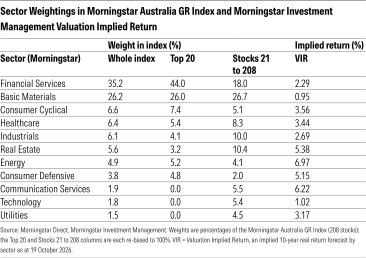
The table below compares the sector composition of the Morningstar Australia GR Index. Financials and basic materials dominate the overall index at a combined 61% weighting, but among the top 20 stocks these two sectors account for 70%. This drops to 45% when we look outside the top 20. Healthcare, Industrials, Communication Services, Technology, Real Estate and Utilities have a much higher representation in the ex20 cohort.
Valuation Opportunities in Small and Mid Caps
Morningstar’s Valuation Implied Returns, which calculate an implied 10-year real return forecast at the sector level shows higher prospective return profiles in sectors that are more prevalent outside the top 20. This suggests an improved return profile is available by taking active risk away from the benchmark allocation at the sector level.
Looking deeper at the stock level, an analysis of Morningstar Equity Research price to fair value shows the top end of the market is fully priced, while the prevalence of discounted valuation opportunities improves. The top 10 stocks in the index are trading at an average premium to fair value of 20%. This compares to a 5% average discount outside the top 20, which increases to a 10% average discount outside the top 50.

The Case for an Active Approach
While valuation metrics may appear attractive, there is a broad dispersion of quality and risk characteristics across the small and mid-cap universe. By their nature, smaller companies tend to be earlier in their business lifecycle, and while this may provide a longer growth runway, it poses additional risks around earnings and cashflow volatility, in addition to balance sheet strength. The smaller end of the Australian share market has a high weighting to resource stocks, which are commodity-price exposed and may have exploration and development risk. There are also a number of loss making companies represented in the index. Smaller companies are less liquid, and may have more concentrated share registers, which can exacerbate share price volatility, particularly during times of market stress (see Figure 3).

For these reasons, an active approach to stock selection is preferred over a passive, market-cap weighted approach for the small and mid-cap segment of the market.
Manager Selection and Business Risk
The trend towards passive investing and the underperformance of active management over the past few years has placed pressure on the business viability of many smaller active fund managers. There have been a number of fund closures over this period, including Novaport, Celeste, Touchstone and most recently Platypus. Therefore, investors should pay close attention to the assets under management, client concentration and strategic commitment of parent firms when assessing the use of active managers for small and mid-cap investing.
Conclusion
Overall, there is a strong case for active management in small and mid-cap Australian stocks, driven by diversification benefits and appealing valuations. However, investors must be conscious of the additional risks involved, and exercise prudence at both stock and manager selection levels.
2027 Outlook: Bonds Are Paying Again, If You Can Handle the Ride
2026 was a bruising year for global government bonds.
The US 10-year Treasury yield peaked at 5.3% in October, a level last seen more than two decades ago, and yields in Japan and the United Kingdom reached or neared multi-decade highs. Because bond prices fall when yields rise, investors have felt it directly.

The selloff has spread across countries with very different economies and central bank policies. Inflation explains part of it. The rest reflects investors rethinking the risk of holding long-term government bonds, against a backdrop of persistent deficits and fading support from traditional buyers.
Entering 2027, our view is that this is a change in the climate, not a passing storm. Rates have moved to a higher floor, and the ride from here will be bumpier. Neither is a reason to avoid bonds, but both should change how investors use them.
Why the Floor Has Moved Up
We raised our estimate of where rates settle over the long run this year. Three forces explain the shift, and all of them reach beyond the US.
- Everyone wants capital at once. AI data centers, rising defense budgets, reshoring and the energy transition are large claims on the world’s savings, and few are deterred by higher borrowing costs. When demand for money outpaces the supply, its price (the interest rate) rises.
- Governments keep borrowing. Deficits remain large across the developed world. The US is running one of about 6% of GDP even with a strong economy.
There is no magic debt level that sets off a crisis. Japan owes about twice as much as the UK and borrows more cheaply. The issue is the ongoing borrowing: as long as deficits stay wide, governments must keep finding buyers.
- And the buyer who never asked the price has left. In 2014, central banks and foreign governments, which bought almost regardless of yield, owned 57% of the US Treasury market. Today they own about 29%.

Same Storm, Different Boats
Inflation is turning higher again almost everywhere globally, and the pressure is spreading beyond energy. But each economy came into this shock from a different place, and central banks are responding differently.
The Fed is weighing sticky inflation against rising growth risks. The UK and Australia face the most stubborn inflation and the most pressure to stay tight. Japan is still gradually raising rates after decades of deflation, while the eurozone, closest to target, can afford to wait.
Those differences shape what each bond market offers. US Treasuries pay well, but for real risks, including the loosest fiscal policy in the group. The UK offers the highest expected return and the strongest fundamentals. Australia is similar, with the healthiest public finances. Japan has the weakest fundamentals, but for investors who hedge from higher-rate countries like the US, the currency hedge adds meaningful return. In the eurozone, inflation is largely tamed, but government finances, particularly in France, remain the weak spot.
What It Means for Investors
Income is back, and it’s a cushion. The silver lining of a bruising year is that bonds are paying again. At today’s starting yields, income rather than price gains does the heavy lifting, and it gives investors a buffer: a portfolio can absorb a meaningful further rise in yields before its return turns negative. That was not true for most of the 2010s.

Plan for swings. With fewer patient buyers, larger moves in bond prices are the new normal rather than a warning sign. Owning the longest bonds isn’t the only way to earn a decent yield and investors can choose where they sit based on how much their volatility tolerance.
Diversify across governments. Central banks are responding to the same inflation shock in different ways, and each government is managing a different debt burden. Spreading interest-rate exposure across developed markets reduces reliance on any one of them. Currency is part of that decision as well, because hedging can add or subtract return.
Know what to watch. We don’t forecast where yields go next, but we know what would change the picture.
- Central bank credibility comes first. While it holds, inflation pressure shows up as higher real interest rates, which bonds can handle. If it cracks, inflation expectations could go higher, the outcome long-term bondholders should fear most.
- Government borrowing plans are second. Bigger deficits, or more issuance of long-term debt, would add pressure at the long end.
- Last is the pace of AI and other investment spending, which will decide how long the competition for capital lasts. Today, the build-out is adding to price pressure through demand for chips, power and construction. Over time, if AI makes businesses more productive, it could ease inflation, though how much remains debated.
The near-zero rates of the 2010s now look like the exception, not the norm. For bond investors, that means less certainty about prices but likely far more reward for holding them.
Artificial Intelligence: Where great expectations meet the capital cycle
AI is the dominant theme in markets, and few dispute its promise. The question for investors is not whether AI succeeds, but whether prices already assume it succeeds.
The dotcom comparison is popular, and some parallels hold: extreme optimism and risks that may not be priced. But there is one important difference. The companies at the centre of this boom – hyperscalers (technology giants building cloud and computing infrastructure including Amazon, Microsoft and Alphabet), data-center operators, semiconductor makers – are earning large profits today, and their share prices, particularly the chipmakers’, reflect it.

Even so, valuations now rest on a build-it-and-they-will-come assumption: that today’s spending will be repaid by tomorrow’s demand.
An alternative parallel to consider is the mining boom from the early 2000s. Real demand from China drove commodity prices higher and sent miners into a capex surge. Earnings soared. But as the cycle ran, companies approved ever less profitable projects and capital discipline eroded. Many investors played the volume story through mining services companies rather than the producers, the picks-and-shovels trade. It ended badly when China’s demand for iron ore slowed just as the new supply arrived. Prices fell, miners cut capex, and the services companies, whose revenue was the miners’ spending, took the hit too.

Investors are playing a similar game with AI compute. A narrow group of hyperscalers, locked in an arms race, has seemingly insatiable demand for components, and the chipmakers supplying them are earning exceptional returns at high margins.
Because of that, they’re now scrambling to add capacity to capture them.
Meanwhile, the revenue actually earned by AI applications remains modest relative to the spending it’s meant to justify. The hyperscalers committed around US$750 billion to capex in 2026, with spending expected to approach US$1 trillion in 2027*. That compares with estimated revenue of around US$100 billion from the leading AI labs*.
The capital cycle is a useful lens for semiconductors. A simple principle: high returns attract capital, incumbents expand, and competition for the same profits loosens investment hurdles. Returns on each new dollar fall, and the cycle often ends in oversupply and poor returns.
With gross margins above 70% at Nvidia and about 80% at Micron*, it provides a warm invitation for new capital. The risk is compounded by an asymmetry: supply is visible, demand is not. Capacity can be counted years ahead, but the end buyers of compute, the AI companies, earn modest revenue today and the payback lies far out. Suppliers are extrapolating from orders that reflect hyperscaler spending, not end demand.
The semiconductor industry has some enviable attributes. It has consolidated heavily, and building capacity takes enormous amounts of money and time, which keeps competitors at bay. Two segments matter most for building AI compute: accelerators and high-bandwidth memory (HBM). Accelerators, of which GPUs are the best known, process vast amounts of data quickly because thousands of cores work in parallel. HBM is specialised memory that sits alongside the accelerator and holds the model’s data. As models grow more complex, HBM’s job is to feed the accelerator fast enough that it isn’t left waiting.
Three companies – SK Hynix, Samsung and Micron – control essentially the entire HBM market. In accelerators, Nvidia dominates, designing its GPUs and relying on TSMC to manufacture them. The growing challenge is custom chips, or ASICs, built for a single customer’s workloads. The difference is like a standard warehouse versus a build-to-suit facility. Nvidia’s GPUs are the warehouse: flexible enough for any tenant to move in and reconfigure. An ASIC is built to one tenant’s specification, cheaper to run for that use but hard to repurpose.
There is clearly a focus on HBM for manufacturers in both expanding capacity and shifting existing capacity. The main players have increased capex significantly, particularly in dollar terms. Micron capex nearly doubled year on year with Samsung and SK Hynix not far behind*. This capacity and others are due to hit the market in 2028-30*, a test for what demand looks like then. It is easy to be relaxed about the capex when viewed in context of current sales but underlying pricing within memory has exploded and should this pricing normalize, as many expect, this capex does not look as rational.
Nvidia is expanding supply within GPU but the largest threat in the supply market here is the hyperscalers themselves. Hyperscalers are looking to both circumvent paying Nvidia in particular by building their own chips with design partners. Not to replace everything but for specific use cases and all claiming at significantly lower cost. Amazon for example has more than $225 billion in revenue commitments for their custom chips*.
Demand is always the less certain side of the equation, but what stands out on this side is how concentrated and interdependent the chain is. Each link relies on a handful of others: chipmakers on a few hyperscalers, hyperscalers on a few AI labs, and the labs on the same suppliers in turn.
Again, a parallel to the resources boom - China was not just a large customer but effectively a single one, because the state controlled the infrastructure program that drove demand, so one policy decision could turn it off. AI compute has a similar shape, with a narrow group of companies both building and using it. The concentration is compounded by ownership. The same companies are customers, suppliers and shareholders at once. As an example:
- Microsoft owns roughly a quarter of OpenAI
- Amazon and Alphabet own meaningful stakes in Anthropic, and both are also its major cloud providers.
- Nvidia has invested in OpenAI, Anthropic and CoreWeave, among others*.
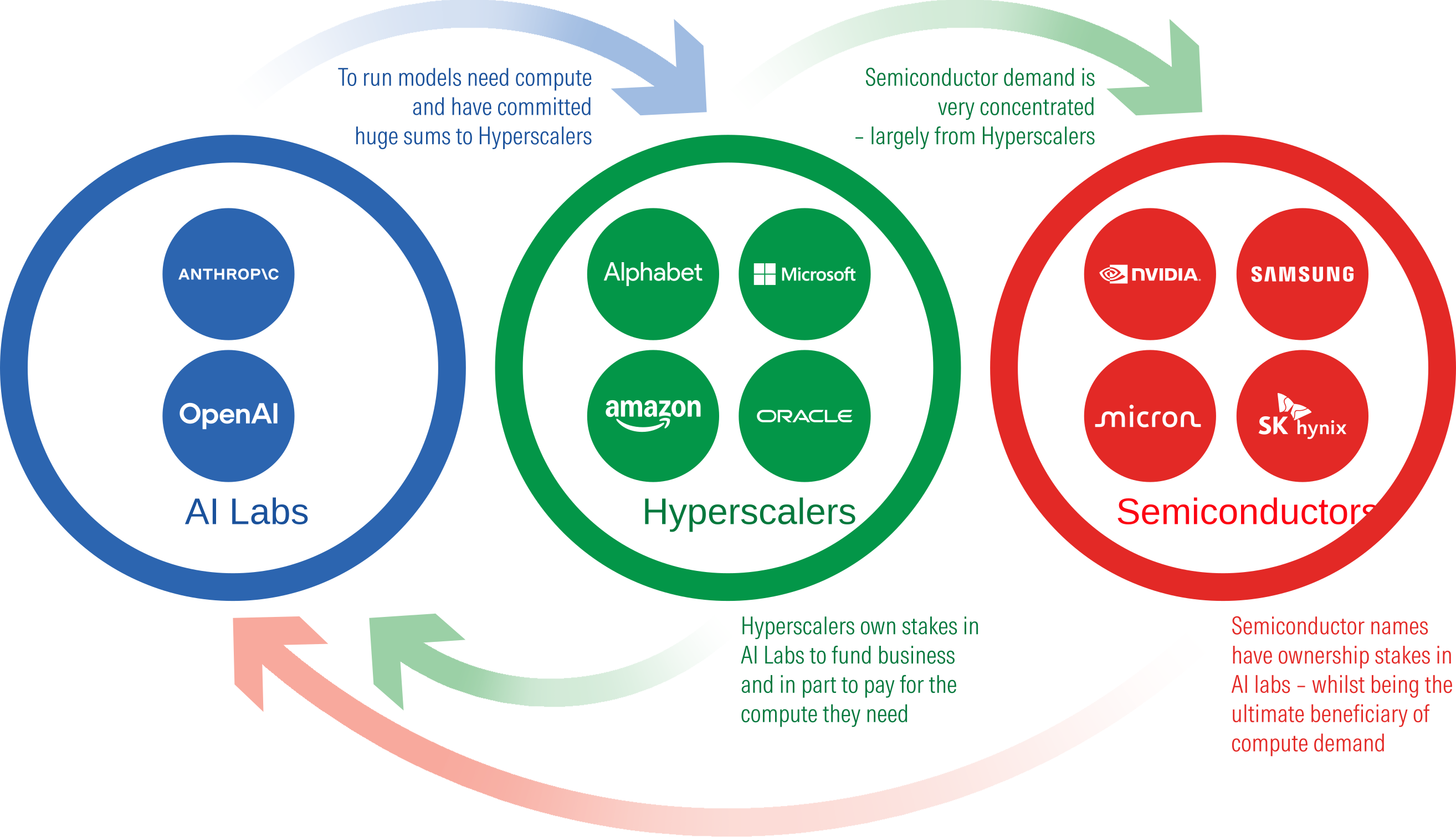
Money goes in as equity and comes back as spending on cloud and chips, so a stumble at one lab would hit its investor’s earnings, its cloud backlog and its suppliers’ orders at the same time. The arrangement works for as long as every party keeps spending, but if any link in the chain breaks, investors could be left disappointed.
So how should investors be thinking about this? Traditional valuation ratios, like P/E, provide an unhelpful starting point. With earnings absolutely booming these ratios hide a key concern – can earnings continue to proceed at this breakneck speed?
An alternative approach is to ask what current prices already imply. They assume the compute buildout continues at pace, setting a high bar and leaving little room for disappointment. For that investment to earn attractive returns, demand for compute must continue to grow, which ultimately requires AI labs to turn technological progress into commercially valuable products and profits, and to capture enough of those profits themselves rather than seeing the benefits accrue elsewhere. That is far from assured. The hurdle becomes higher still when we consider the capital-cycle dynamics, the concentration of the AI ecosystem, and the possibility that more efficient models or new technologies allow more to be done with less compute. With so much already embedded in expectations, even good outcomes may not be good enough.
That leads to perhaps the final lesson from the mining boom: the most popular destination for capital is not always the best place to invest. As money floods into AI, perhaps investors should spend more time looking at what it is leaving behind: good businesses, starved of capital and attention, where expectations and valuations are considerably lower.
*Sources:
1. Company reports and broker estimates2. Per Bloomberg reports
3. Pitchbook and Company reports
4. Company reports
5. SEMI, Gartner as of September 2026
6. Amazon Q1 2026 Earnings Call.
7. Microsoft 10-Q (March 2026); Amazon 10-Q (June 2026); Alphabet 10-Q and court filings (2025); Nvidia 10-Qs (FY2026–27). So company filings.
Not Every Investment Should Need AI to Succeed
Most portfolios already carry substantial exposure to AI through their benchmarks, whether by design or by default. The promise of the technology is not in dispute. The question is whether a portfolio can still deliver if that promise falls short. A portfolio that only works if AI succeeds is not diversified. It is a bet on a single outcome.
Resilience is easy to overlook when concentration has been rewarded, but it rests on three things: high-quality assets, bought at sensible prices, and combined so that they do not all depend on the same outcome.
Competitive advantage will decide who keeps the gains
AI succeeding as a technology and AI succeeding as an investment are not the same thing. In most technology cycles, from the railways to the fibre-optic boom of the late 1990s, the benefits accrued to consumers and to the businesses that adopted the technology, not to those who financed its construction. AI shows signs of following suit. Customers can switch between models as price and performance shift, so competition among model developers and application providers is likely to compress prices. A technology can transform society while delivering modest returns to those who supply it.
The same logic applies to companies adopting AI. Cost savings available to every competitor will be competed away unless a company has a durable competitive advantage. This is the capital cycle at work: returns that others can copy attract competition until they disappear. AI is also disruptive, as likely to erode some established advantages as to strengthen others. Investors should still try to judge which advantages will endure, but that judgement is uncertain, and it is only one of several possible outcomes.
Diversification is thinner than it looks
That uncertainty argues for diversification. Yet a market-capitalisation-weighted index is not neutral: it assigns the largest weightings to the companies whose values have risen the most, which today leaves global equity indices heavily weighted toward AI and US technology. Nor does an index distinguish between securities trading below intrinsic value, the present value of the cash they will generate, and those trading above it.
Holding hundreds of companies is not the same as being diversified. The AI enablers (chipmakers, data centre operators, utilities, construction firms and industrial suppliers) sit in different sectors but share a single driver: continued growth in AI spending.
Timing matters too. Assets differ in when their cash arrives, and those that earn most of it in the distant future are far more sensitive to the cost of capital. It is the logic of bond duration, applied to equities. Semiconductor makers are highly profitable today, but the return on the capital spending those profits depend on remains uncertain. A portfolio concentrated across this chain is exposed twice: once if the payback proves slower or smaller than hoped, and again if the cost of capital rises. Businesses with nearer-term cash flows that do not rely on this spending respond differently on both counts.
Diversifiers beyond the AI trade
Genuine diversification requires a deliberate step away from the capital-spending cycle that dominates today’s market, toward assets whose returns depend on different things. It also means holding a range of vintages: assets at different stages of their cycle. Some are out of favour and may take longer to come good. Others have improving fundamentals ahead of the price and could re-rate sooner. Others have already caught up and earn their place through their different drivers. Because vintages are mispriced at different times, they respond differently to the same news. A portfolio concentrated in the AI enablers shares a single point in the cycle, on a single timetable.
The areas below diversify against AI exposure:
- Consumer staples tend to be less dependent on AI. Demand for food, household goods and personal care changes little with the economy, which h/elps hold earnings up if the cycle disappoints.
- Healthcare has structural support from ageing populations and pharmaceutical innovation, and could benefit as a user of AI, for example in drug discovery and diagnostics. Demand for treatment is largely unrelated to the AI investment cycle.
- US small- and mid-cap equities offer a different industry mix and less concentration in AI-linked companies than global indices. So do markets such as Australia, where the index is weighted toward financials and resources. Some US mid-cap industrials still depend on AI spending, so stock selection matters.
Beyond equities, high-quality sovereign bonds are another source of diversification. In September 2026, the US 10-year Treasury yield rose above 5%, and it peaked above 5.3% in October. Australian 10-year yields reached their highest level since 2011. Yields have since fallen from their peaks, at times sharply when equity sell-offs reflected concerns about the scale and prospective returns of AI data-centre investment, lifting bond prices and providing protection to diversified portfolios. That protection is not unconditional: yields also respond to inflation, central bank credibility and government borrowing, and volatility is likely to remain higher than it was in the 2010s. Even so, with yields still above pre-pandemic levels, income provides a meaningful cushion, while there remains scope for capital gains if weaker growth pushes yields lower.
Conclusion
AI may transform the economy, but much of the value is likely to accrue to consumers rather than to those who supply the technology. We can’t predict whether AI delivers on its promise, but we can prepare. That means holding assets at different stages of their cycle, sizing each allocation so that it adds real diversification without forgoing the return from themes that may keep working, and rebalancing with discipline by trimming what has risen most and adding to what has lagged, even when it feels uncomfortable.
Above all, it means ensuring that not every investment needs AI to succeed.
Momentum is not a one-way bet?
Momentum-based investing has attracted significant inflows following strong performance. Are there risks associated with increasingly crowded positioning?
Change is constant and nothing lasts forever. In the world of investing, momentum – the simple premise that assets that have performed well recently will continue to perform well in the future – has proven to be a winning strategy over time. Likewise, momentum tends to work in reverse where poorly performing assets often continue to underperform.
This style of investing has become increasingly popular, particularly within equities, as investors increasingly favour passively-managed market cap-based index strategies, factor-based, and quantitative strategies (which frequently incorporate momentum alongside other investment signals), as well as fundamental-based active fund managers increasing their use of momentum investment signals. Given the variety of ways investors may look to undertake momentum investing, we think it’s important to distinguish between momentum investing strategies which solely focus on price momentum, and those that look to incorporate momentum in an asset’s underlying fundamentals (for instance, earnings momentum). For simplicity, our focus here is on price momentum-based equities strategies.
The most commonly adopted price momentum investing equities strategies are passive or index-based strategies which look to mimic a market cap-weighted index, where individual asset weights are determined based on each security’s most recent market price. Market cap-based index strategies can serve a useful role in wholistic portfolio construction in providing market portfolio exposure at generally lower management fees and transaction costs. What’s more, according to Morningstar’s Active/Passive Barometer report*, the average active manager in each major equity market has struggled to beat its average passive manager peer over the last decade. Given this performance differential, it’s not surprising to see investor flows favouring passive strategies, albeit noting the important caveat that (superior) past performance is not indicative of future returns.
Source:
*US Active/Passive Barometer Report: Mid-Year 2026, 6 Aug 2026
What may change in the future?
With investor flows continuing to favour passive management, it’s important to consider what are the risks posed? There are two main potential drawbacks with owning a strategy that solely relies on asset prices to determine portfolio exposures:
1) individual asset portfolio weights may reflect historical fundamentals rather than future fundamentals;
2) individual asset prices can become significantly disconnected from their fundamental value.
Momentum-based investing equities strategies have historically not done well when market leadership changes. While persistence in market leadership may be observed over short periods of time (12 months or less), yesterday’s winners are unlikely to remain tomorrow’s winners over longer periods. As an example, the country weights within major global equities market indices have changed markedly over the past few decades. During the late 1980s, the Japan equities market size represented between 35 – 45% of global equities market indices.. Today, Japan represents less than 10%, and US equities represents over 50%, following a strong period of outperformance.
Not only have we seen changes in equity market composition, we have seen changes in the composition of investors and market participants. The total share of passively managed funds within the US market has increased at the expense of actively managed strategies over the last decade.

As the composition of market participants has changed, passively-managed strategies comprise a greater proportion of trading activity, rather than actively managed strategies. This means that more marginal trading activity is coming from investors who are price insensitive and are less concerned about the connection between an asset’s price and its fundamentals (most notably, the asset's income and earnings).
Why does the link between price and fundamentals matter? Over the long term, an asset’s price is linked to its underlying fundamentals, most notably earnings.
With data going back to 1950, the correlation between the US market’s stock prices and earnings has been 97%.

Valuation changes have a big impact on equities returns over shorter periods, but in the long term, it’s clear fundamentals hold major influence.
Momentum's widespread adoption reflects both its historical effectiveness and its diversification benefits when combined with other investment factors and styles. We think the evergreen investing tenets of portfolio diversification and fundamental value continue to hold true for long-term investors. No single investment factor has been shown to consistently work all the time, and we’d caution against using momentum as a sole investing approach.
Momentum investing is not a one-way bet to winning. As always, change is constant.
What experienced advisers do before markets fall
We asked a global panel of established financial advisers what they do to help their clients endure volatile markets. Most of the work, it turns out, is done before anything happens.
Key takeaways
- Perceived volatility depends on how often one looks. The same equity portfolio shows a gain about 74% of the time when checked yearly and about 54% of the time when checked daily.
- The clients most likely to reach out during a downturn are the inexperienced, those drawing income and people who are generally more anxious; all three can be identified in advance.
- Clients ask about market mechanics and their own performance; almost none ask about opportunities or their goals, which is exactly where the adviser should steer them.
- Most practices have an investment policy; few have a volatility policy. A written process for before, during, and after is a capability that scales.
Introduction
Imagine an investor who has held a broad basket of US equities since the 1980s and who looks at her portfolio once a year, on the first trading day in January. Nothing else about her is notable; she is simply disciplined about when she checks her performance. Over those years, she sees a gain about three times out of four. Not bad.
Now consider another investor with exactly the same investments, but this investor looks at performance every day—same assets, same rebalancing, same fees, same returns. This investor has a very different experience and sees a gain only about 54% of the time.


The only difference between these two investors is their behaviour, and the consequences are stark. Investors who look more often see (and feel) more of the market’s ups and downs, and that alone can lead to bad choices. Loss aversion makes it such that losses hurt more than gains feel good, and frequent checkers see more losses. That can tempt people to fiddle with their portfolios and deviate from their investment strategy.
Helping clients withstand volatility is among the most valuable services a financial adviser provides. But how advisers do this coaching is rarely well documented. Most practices have an investment policy; few have a volatility policy. To shed light on what a “volatility policy” could look like, we asked Morningstar's global panel of established financial advisers, who average of about two decades of experience each, what they do when markets turn volatile, what works, and what they have changed over the years.
Their answers sort into three phases, and most of the work happens well before volatility strikes.
Before: what do you mean, if?
The most useful volatility conversations happen in calm markets, when fear is low, and the client is paying attention.
Start with the word "if." A client who asks, "What happens if there’s a downturn?" has offered an excellent opening, and the useful reply is to push back on that one word: “What do you mean, if?”
Over the last 90 years, the US economy has gone through roughly 15 recessions. A bear market (defined as a 20% fall from a peak), has arrived about six times in the last 50 years. Loosen the definition to a 19% drawdown and the count rises to nine, or one about every six years. A household investing for the next 25 years should expect about four. It’s not if volatility will come, but rather how many times. Volatility is an inherent part of investing; it’s the ticket to ride.
A useful follow-up question is, “Given that volatility is part of investing, what are we going to do when it happens?” This gives clients a chance to pre-commit. Some advisers have clients write a note to their future selves during a calm moment, positing their plan and the reasons for it. It also helps refocus clients on their long-term financial goals. This shifts their attention from the short-term to the long-term and reminds them of their “why” as investors.
Market panics can produce bargains for anyone with cash and a plan to deploy it. Warren Buffett reminds investors “to be fearful when others are greedy and greedy when others are fearful.” The adviser’s job is to make sure clients remember that when fear is running high.
During: who calls, and what they ask
Advisers told us the first calls come from inexperienced clients, those new to investing or new to the practice, followed by clients who rely on their portfolio for income. And no surprise, they also report hearing from clients who are more naturally anxious. All three groups can be flagged in advance. A risk-tolerance questionnaire at intake helps here, both to measure how people might react to losses and to start a structured conversation about what a major fall in portfolio value would feel like.
When volatility strikes, clients often ask, “what’s causing this?” and “why now?” Markets are complicated, and multiple interlinked causes typically arrive together. Advisers should have a few plain talking points on the major drivers. But the main point should be about what investors can control, which is not the market but their own behaviour. Clients also ask about performance, but several advisers said the real question underneath is, “Am I going to be OK?” That’s the question worth hearing and answering.
Two topics stand out for their absence. Very few clients asked about opportunities, and very few revisited their long-term goals. Anxiety narrows attention. People under stress focus on the short term and on what the market just did to them, and they lose sight of why they invest in the first place. The adviser's job during volatility is to widen the frame again and shift the client’s focus from the short term to the long term.
After: what changes with experience
The most consistent theme across the panel was a shift in role. With each market cycle, advisers move from managing investments toward coaching the investor. The person, not the portfolio, becomes the focus of their work. Advisers reported they better guided clients through volatility by having:
- More confidence in anticipating which clients will need reassurance to make the first move
- More deliberate communication (active listening, empathy, avoid jargon)
- A small set of facts kept ready, like the bear-market count above, to steady and reframe the conversation.
Conclusion
The industry has leveraged technology to build remarkable systems for showing clients what the market did today. Information now arrives in near real time on handheld screens and even watches. But that can fuel a short-term mindset. Non-stop information can also create anxiety and push people to focus on things they simply can’t control. Good advice is a counterweight to this urgency. Skilled advisers help focus on their financial goals, the long term, and the real drivers of their success: Contribution rate and the ability to stay invested through full market cycles. Good advisers know the question isn’t if volatility will come, but what to do when it does.
Download as a PDF: Australian and Global Market Outlook 2027