
5 min read
Oil and Gas Industry Overview: Reviewing Opportunities

Key Takeaways
US-Iran resolution may not be final, but “lost” supply might not have been as significant as initially expected.
If the US-Iran deal holds, the market could become oversupplied, while the UAE’s departure may weaken OPEC’s influence.
The North American energy sector now looks fairly valued, with Devon Energy and Energy Transfer remaining top picks and Antero joining the list.
Oil and gas markets are entering a new phase as the US-Iran peace deal eases supply concerns and pushes crude prices lower. With disrupted volumes expected to return and geopolitical risks still lingering, investors are reconsidering opportunities across the sector.
In our Q2 2026 Oil and Gas Industry Pulse report, Morningstar’s Equity Research team explored supply recovery, commodity price trends, the evolving influence of the Organization of the Petroleum Exporting Countries, or OPEC, and top energy stocks.
Supply Disruptions May Be Less Severe Than Feared
US-Iran resolution may not be final, but “lost” supply might not have been as significant as initially expected. In fact, physical markets arguably tell a different story than trading volumes so far. Rystad pegged lost oil volumes at roughly 12 million barrels of daily production at peak. Yet traders peg lost volumes far lower at between 5 and 6 mmb/d, suggesting some flows worked around Hormuz. The disconnect likely stems from producers diverting oil through pipelines or smuggling it via shipping.
Several factors have kept oil prices from running higher as well. Aside from alternative routing and logistics workarounds, the US significantly ramped up its exports after drawing on its strategic reserves. Also, Asia significantly cut back its oil consumption in reaction to the supply shortages.
Recovery Could Shift Markets Toward Oversupply
Some observers are concerned that the hardest issues in the US-Iran deal remain unresolved, including who will control the Strait, whether shipments will require toll payments, and when mines will be cleared. These issues impact the confidence of shippers and insurers alike, translating to a potential residual premium between $5-$10/bbl.
But if the deal holds, the market could become oversupplied from high prices impacting demand, setting up future stock bargains.
The UAE’s Departure May Weaken OPEC’s Influence
Oil markets likely won’t immediately notice the impact of the UAE’s departure, but it could have long-term repercussions. In sum, we believe it’s a foreign policy win for the US, as losing one of the Middle East’s top producers undermines OPEC’s influence and pushes the UAE closer to the West.
The UAE’s also been one of the few members with meaningful spare capacity, which helps OPEC exert influence over global prices. In the future, it could seek to profit from its low-cost reserves, possibly pushing supply higher and lower prices.
Capital Allocation and Rig Activity Reflect a More Measured Outlook
Some producers returned cash, but many fortified their balance sheets during the quarter. If markets move from undersupplied to oversupplied, we’d expect producers to deploy cash and make opportunistic repurchases.
Meanwhile, commodity volatility continues to harm near-term dealmaking but M&A could resume if geopolitical tensions really do calm. We also note that a “wartime” cash windfall looks far less likely now.
Producers in other capital-intensive commodity sectors, including the building materials industry landscape, are navigating similar trade-offs between capacity investment and pricing discipline.
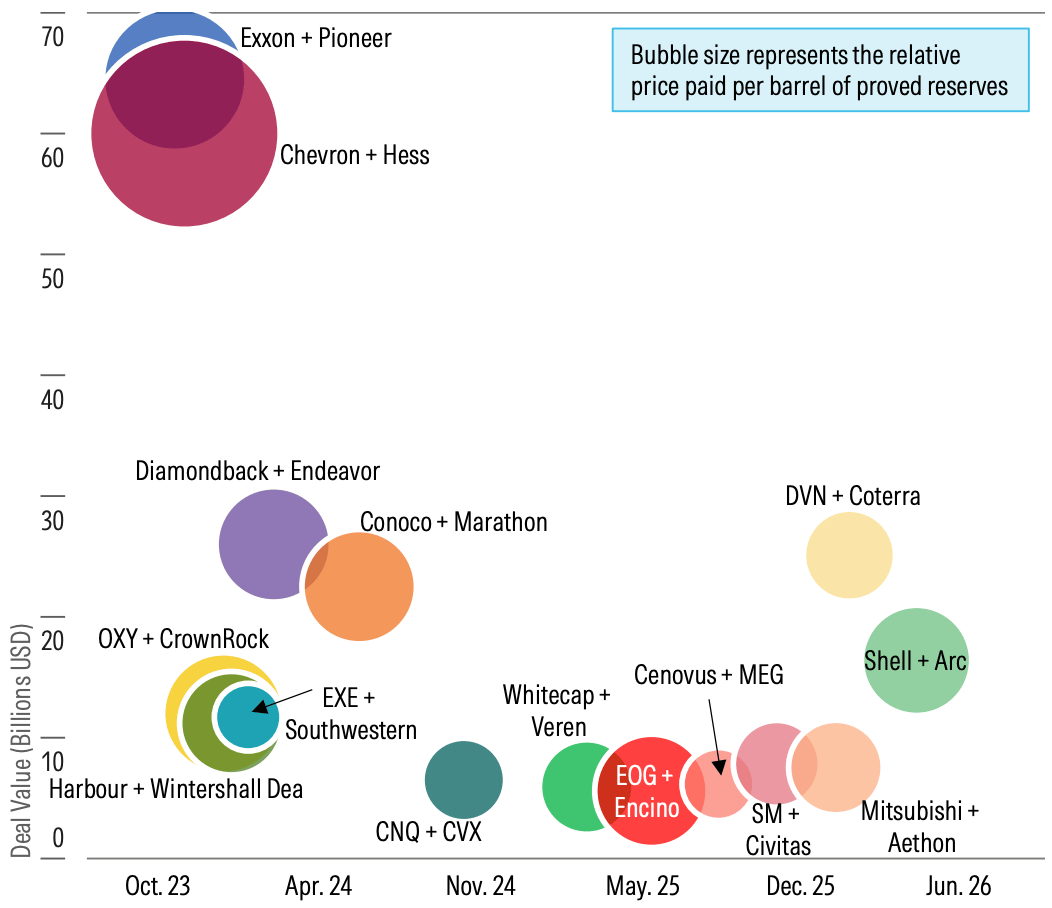
Source: Rystad. Company filings. Data as of June 9, 2026. Note: DVN is Devon Energy. OXY is Occidental Petroleum. XOM is ExxonMobil. FANG is Diamondback Energy. CVX is Chevron. CNQ is Canadian Natural Resources. SM is SM Energy.
At the same time, oilfield services stocks baked in a lot of enthusiasm relative to fundamentals. Despite higher oil prices, the US oil rig count increased marginally during the quarter while US gas rigs have been declining amid efficiency gains and lower gas prices.
US-Iran Deal Is Starting to Create a Better Opportunity Set
The North American energy sector now looks fairly valued. Our global energy coverage trades at a 1% premium, meaning prices swung from overvalued last quarter to reasonable in the second quarter.
Declining oil prices had a greater impact on E&Ps, exploration and production firms or operators who explore, develop, and extract resources like oil and gas from the ground. We like them the most, while refiners are the least attractive on valuation.
Devon Energy and Energy Transfer remain top picks while Antero joins the list.
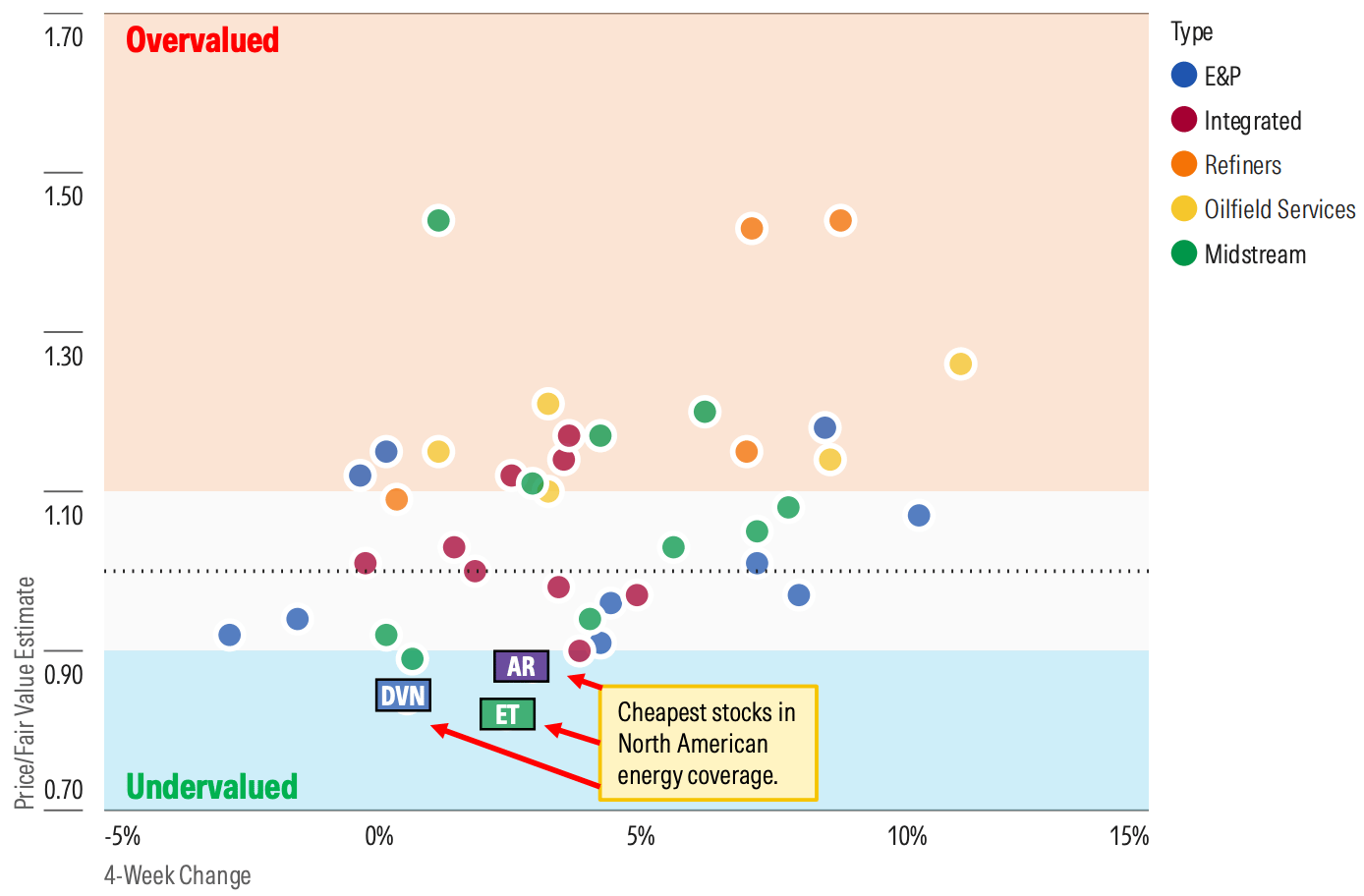
Source: Morningstar. Data as of June 5, 2026.
Our top stock picks in oil and gas include:
- Devon Energy DVN: This US E&P closed its merger with Coterra. Bears frown on the multibasin, multiresource story, but gas exposure should help Devon long-term. We like the upside from the deal’s cost savings, and management’s execution and capital return record.
- Energy Transfer LP ET: Complexity hurts its story, but we like this midstream firm’s exposure to Gulf Coast LNG demand and new data centers in Texas. The cancellation of the Charles Lake project frees up capital for higher-return projects and offers an attractive yield.
- Antero AR: Complexity hurts its story, but we like this midstream firm’s exposure to Gulf Coast LNG demand and new data centers in Texas. The cancellation of the Charles Lake project frees up capital for higher-return projects and offers an attractive yield. Antero's long-haul transport contracts give it priority access to LNG export pricing; so, it should benefit from soaring overseas demand for US natural gas, while its hedge book offsets near-term price volatility.
Download the free report for more commentary and robust industry dashboards covering the oil and gas sector.
The original publication launched on June 30. Since that time, the Memorandum of Understanding between the US and Iran is effectively defunct. Hostilities have ramped higher between the two nations, and the MOU’s 60-day deadline is set to expire Saturday, August 15. While our long-term midcycle oil price and outlook hold, as we continue to think of the war as only disrupting supply, we speculate that near-term supply disruptions could continue into next year the longer hostilities persist.