
7 min read
Active vs. Passive Fund Performance: When Do Active Managers Win?
While passive funds dominated in 2025, strong active investing opportunities still exist.

Key Takeaways
- Long-term success rates for US actively managed funds were generally higher among real estate and bond funds, but lowest among US large-cap strategies.
- European active managers tend to achieve higher long-term success rates with mid-cap and small-cap equity funds than with large-cap funds.
US actively managed mutual funds and ETFs struggled to outperform their average passive peer in 2025. Just 38% of active strategies survived and beat their asset-weighted average passive composite, a drop of 4 percentage points from a year earlier.
That did little to change their long-term track record. Just 21% of active funds survived and beat their average indexed peer over the decade through 2025.
But some active funds are worth the premium in fees and expenses.
Morningstar’s investment research assesses the long-term success rates of active funds compared with passive funds. Here are the categories where actively managed funds stood out and where they fell short.
For a full breakdown, download the free Active vs. Passive Barometer report.
Choose Your Full Report Edition
Passive Funds Continue to Attract Inflows
Total assets in US passive mutual funds and exchange-traded funds first surpassed those in active ones in 2024—and the gap has continued to widen. Recent data show that passive strategies continue to dominate investor demand, capturing the majority of new inflows across key asset classes, particularly in US equity funds.
Active investing strategies often come with higher expenses for manager skills, involvement, and specialized analyst teams. Over the past decade, inflows in the United States have tilted toward passive funds with consistent outflows from actively managed strategies and strong inflows into passive vehicles reflecting demand for cost-efficient, broad market exposure.
In Europe, active investing continues to dominate assets. As of the first quarter of 2026, active equity funds held approximately EUR 4.1 trillion in assets, compared with about EUR 3.4 trillion in passive equity funds.
In the first quarter of 2026, passive funds attracted EUR 120 billion in flows—nearly double the EUR 64.1 billion gathered by active funds—with passive equity strategies alone drawing a substantial EUR 108 billion.
European funds gathered EUR 184.2 billion of inflows in the first quarter of 2026, bringing total assets to just over EUR 14.0 trillion. While geopolitical uncertainty led to some outflows in March, the broader trend reflects continued investor engagement, particularly with equity and globally diversified strategies.
Across equity markets, a clear divergence remains: passive equity strategies continue to dominate inflows, while active equity funds have experienced persistent outflows, shedding EUR 12.7 billion in the first quarter of 2026 alone.
How We Created the Active vs. Passive Barometer
Our researchers used Morningstar’s comprehensive fund data to calculate a category’s success rate, or the percentage of active funds that survived and outperformed a composite of passive funds over time.
Why a composite?
This “benchmark” reflects the net-of-fees performance of investable passive funds. It factors expenses into analysis for a more parallel look at trends in active-fund success.
As of year-end 2025, the report spans:
- Nearly 9,248 unique US funds with approximately USD 26 trillion in assets, or about 67% of the US fund market.
- Around 32,000 unique active and passive European funds that account for about half the assets of the European fund market.
- 4,480 unique China funds that were alive at the start of the trailing one, three, five, or 10 years ended Dec. 31, 2024.
When Does Passive Investing Outperform Active Investing?
US actively managed mutual funds and ETFs struggled to outperform their average passive peer in 2025. Just 38% of active strategies survived and beat their asset-weighted average passive composite, a drop of 4 percentage points from a year earlier.
That did little to change their long-term track record. Just 21% of active funds survived and beat their average indexed peer over the decade through 2025.
The US large-cap market has been particularly challenging for active managers due to its high transparency and efficiency, which leaves little room to add value over representative indexes. Just 10% of them survived and beat their average passive rival over the decade through 2025.
Across large-cap categories the distribution of 10-year excess returns skewed negative for surviving active funds. That indicates the penalty for picking an unsuccessful manager outweighed the reward of picking a winner.
Active large-cap funds in other regions also struggled to beat their passive peers. Faced with the strong tailwind behind market indexes in the eurozone, those large-cap managers notched a 17.3% success rate in 2025. And despite attractive valuations, UK large-cap managers finished 2025 with a 28.0% success rate.
All told, these US active fund categories fell behind their passive counterparts in 2025:
- Real estate fund managers saw their one-year success rates plummet to 12%.
- Bond fund managers had a 40% success rate.
- Large-cap fund managers had a 36% success rate, with large-value managers as a bright spot at 60%.
- Mid-cap fund managers had a 36% success rate.
- Small-cap fund managers had a 38% success rate.
In Europe, these active fund categories trailed passive peers:
- Europe ex-UK equity funds had a 22.9% success rate.
- Europe small-cap equity funds had a 26.7% success rate.
- Eurozone large-cap equity funds had a 17.3% success rate.
- Eurozone small-cap equity funds had a 10.4% success rate.
When Does Active Investing Outperform Passive Investing?
Generally, active managers tend to achieve higher success rates in less efficient markets where a sufficient advantage can be found.
Active fund performance varies across investment categories and periods. In some regions, they remain the dominant approach in assets under management.
Active Fixed-Income Funds
Active US bond managers’ fortunes reversed in 2025. Across the three fixed-income categories included in the study, success rates plummeted 24 percentage points to 40%.
Active intermediate-core bond managers led the cohort with a 55% success rate, while active corporate-bond managers saw a paltry 4% success rate.
However, their European counterparts have found continued fertile terrain. The active managers’ weighted average success rate over one year came in at 55.8% at the end of 2025 for the 21 bond categories examined.
Over longer horizons, the success rate for active bond managers falls as the benefits of compounding low fees charged by passive funds kick in. But even on a 10-year basis, it stood at a very respectable 31.5%.
Active Ex-US Stock Funds
The global- and foreign-stock categories have been a bit kinder to active managers than the US market segments. At 24%, foreign-stock funds’ 10-year active success rate measured up better than the 16% rate for active US stock funds.
International-stock managers fared relatively well in 2025. Active funds in five foreign-only Morningstar Categories saw their collective success rate increase to 48%, up 8 percentage points from the year prior. Diversified emerging-market funds were to thank after posting the top success rate among all categories at 64%, a 42-percentage-point increase from 2024.
Diversified Emerging Markets
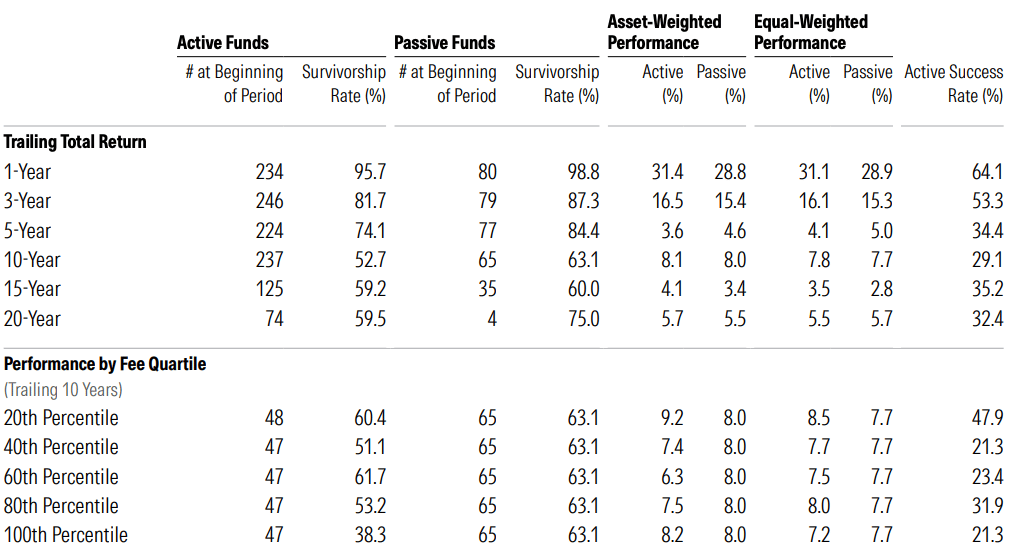
Source: Morningstar. Data and Calculations as of Dec. 31, 2025.
However, woes continued for active global large-blend funds, which combine foreign and domestic stocks, despite a small uptick in success rates. Nearly 26% of global large-blend managers beat the passive benchmark in 2025, up 6 percentage points from 2024.
In Europe, the one-year success rate for active emerging-markets equity managers was 49.6% in 2025. Fund flows told the story of rebalancing portfolios away from US equity, mainly onto European and emerging-markets funds. Investors showed a clear preference for passive options.
How to Compare Active vs. Passive Funds in Morningstar Direct
Active vs. passive investing statistics can help professional investors calibrate the odds of succeeding with active funds and ETFs in different categories.
From there, how do you pick the winners to buy?
Evaluating fund activeness
High tracking error and active share don’t guarantee superior performance but do offer one way for active funds to justify their fees. Some active funds closely replicate the asset weightings of an index fund, but at a higher price point.
Divide a fund’s active share or tracking error by its expense ratio and compare it to a custom benchmark or peer group.
This gives you one indicator of the difference between an active fund and its cheaper passive alternatives.
Assessing portfolio manager track record
When evaluating active managers, our researchers consider factors such as the people managing the portfolio, their process, and whether the parent firm aligns its interests with investors.
With performance comparison tools like Morningstar Direct, portfolio managers can perform complex analyses on investments faster than ever.
- Direct’s browser access lets you get jobs done from any computer, anywhere. The in-browser Direct experience serves up all of your information and Direct’s data, research, and report templates from any computer with a web browser.
- Search criteria: Save and update your searches to effortlessly track investments that align with your evolving needs. Each search provides up-to-date results, empowering informed decisions. Leverage advanced searches and filters to quickly uncover investments that match your criteria. Use pre-existing search parameters or create new ones with ease for streamlined, accurate exploration and comparison.
- Performance reporting: Gain actionable insights into portfolio strengths and weaknesses with custom performance reports. Select investments, set benchmarks, choose time periods, and display over 1,000 data points—from long-term returns to expense levels. Embed Morningstar Medalist ratings, apply conditional formatting, and use custom scorecards to analyze results based on your strategy. Automate reporting with scheduled data pulls to stay ahead of market trends.
- Holdings: Leverage Morningstar’s trusted fund holdings data to enhance portfolio construction, manage risks, and comply with regulatory standards. With security-level visibility, Morningstar supports over 200 financial institutions globally in uncovering performance drivers and delivering value.
- Dynamic charts and graphs: Explore dashboards and interactive visuals for performance, liquidity, attribution, and risk models, providing powerful tools for analysis and decision-making.