
5 min read
Diversification Had Its Best Year Since 2009. Here's What Drove It.
Our diversified test portfolio outperformed the standard 60/40 allocation in today’s market.

The year 2025 was a watershed moment for investors who stayed diversified. The persistent narrative that diversification is dead took a substantial hit when a broadly diversified portfolio outpaced a plain-vanilla 60/40 asset allocation by 5 percentage points. This represented the widest margin of outperformance since 2009.
But what drove that gap, and what does it mean for how financial advisors should think about portfolio management going forward?
This article draws on the Morningstar 2026 Diversification Landscape report to highlight key takeaways. We'll cover everything from fixed income and real assets to alternatives and inflation protection, providing actionable insights for your investment portfolio construction.
Why Portfolio Diversification Outperformed in 2025
In our test, the broadly diversified portfolio returned 18.3% in 2025, compared with a 13.3% return for a standard 60/40 portfolio consisting of US stocks and US investment-grade bonds.
Several factors contributed to this outperformance.
- A surge in gold: Gold climbed 67.4%, reinforcing its role as one of the most effective commodity diversifiers.
- Stronger performance from non-US assets: International stocks outpaced US equities by a wide margin, benefiting from a weaker US dollar and relatively lower starting valuations.
- Lower correlations: Many asset classes moved less in lockstep, improving the effectiveness of diversification, particularly during periods of market stress such as tariff-related volatility earlier in the year.
There is an important caveat for long-term portfolio management. Over most trailing 10- and 20-year periods, the standard 60/40 asset allocation still led on risk-adjusted returns. However, 2025 proved that when broader asset classes align favorably, the stock market does not have to be the sole driver of growth.
Why the 60/40 Portfolio Split Works and When to Go Further
The standard mix of US stocks and investment-grade bonds remains formidable.
Over most trailing periods in the past two decades, a basic asset mix of US stocks and high-quality bonds outperformed more broadly diversified portfolios. The standard 60/40 asset allocation also delivered stronger risk-adjusted returns in every rolling 10-year period since early 2005.
The strategy provides a reliable way to protect against loss and manage investment risk over long horizons.
However, the landscape is shifting. Correlations between US and non-US stocks are trending lower, reflecting a weaker dollar and increasing fragmentation in global trade. This divergence may be opening a new window for broader diversification strategies.
Additionally, the stock and bond correlation returned to negative territory in 2025 after displaying elevated, positive readings from 2022 through 2024.
The takeaway for financial advisors is straightforward. You do not necessarily need to move clients too far beyond large-cap stocks and high-quality bonds to build effective portfolios. But targeted additions, particularly in environments like 2025, can improve outcomes at the margin.
Asset Classes and How Correlations Shift Across Market Conditions
Asset class correlations are dynamic. They tend to spike in bear markets, reducing risk mitigation exactly when it is needed most. For example, stock and bond correlations turned positive during periods of high inflation historically and remained elevated from 2022 through 2024. The lower the correlation, the greater the reduction in volatility from adding additional assets.
Rolling Three-Year Correlation Trend: Diversified Portfolio vs. Morningstar US Market Index
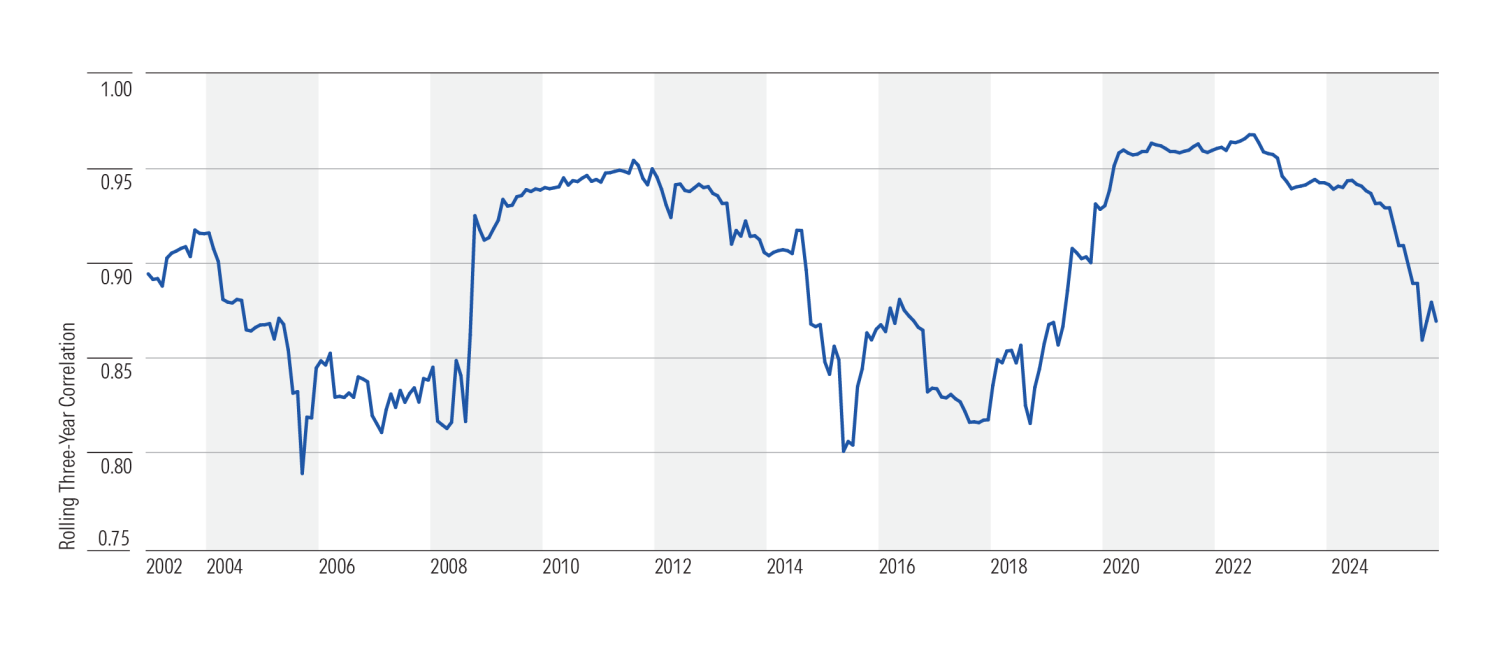
Source: Morningstar Direct. Data as of Dec. 31, 2025.
We are seeing new trends in recent years. Correlations between the US and developed international markets have trended lower since 2022 as the dollar weakened and global trade fragmented. In these conditions, geographic diversification can reduce reliance on one country's economy.
For effective portfolio management, patience is essential. Rolling three-year correlations eventually reset, even after painful rate pivots. By staying the course, financial advisors can help clients realize the long-term mathematical benefits of holding uncorrelated assets. Good rebalancing decisions require looking past short-term regime changes to protect against loss over the long run.
What are the best diversified portfolio strategies for inflation protection?
Stocks and bonds tend to move more in tandem during inflationary periods, but bonds can still provide significant diversification benefits, as well as play a critical role in providing ballast and reducing risk.
Historically, these asset classes have been valuable hedges against inflation risk.
- Commodities have excelled during past high-inflation periods, particularly gold and oil. Gold maintained a near-zero correlation to equities. This makes it one of the most reliable alternative investment options for navigating turbulent markets.
- Treasury Inflation-Protected Securities, or TIPS, offer direct inflation hedging. They are especially useful when they offer real positive yields.
By contrast, both stocks and core bonds have struggled during sustained inflation. Higher inflation typically makes for a more challenging environment for stocks, as it leads to higher operating costs in the form of raw materials, components, wages, and other expenses.
Higher inflation can also make conditions challenging on the fixed-income side, but the impact is usually less direct. A surge in inflation often prompts the Federal Reserve to hike interest rates, reducing bond prices and leading to tighter comovement between stocks and bonds.
What are the best diversified portfolio strategies that include real assets like REITs and commodities?
Shifts in supply and demand, rather than corporate earnings or balance-sheet fundamentals, drive commodity prices. As a result, they have historically exhibited low correlations with traditional asset classes such as stocks and bonds, giving them potential value as portfolio diversifiers.
By year-end 2025, the three-year correlation between the Bloomberg Commodity Index and the Morningstar US Market Index dropped to just 0.05. However, outcomes can vary across individual commodities, underscoring the importance of thoughtful exposure.
- Gold remains the most reliable defensive allocation among commodities, exhibiting consistently low correlation with equities and demonstrating resilience during periods of heightened uncertainty.
- Energy and industrial metals continued to offer diversification benefits over full market cycles, but their performance was more closely tied to growth expectations, policy developments, and supply responses. As a result, these segments may be less effective as short-term hedges during equity drawdowns.
While often used as a diversifier, real estate investment trusts can suffer during periods of rising rates because higher rates on investment-grade bonds make REIT yields less competitive. REITs have also sometimes fallen in step with equities in economic downturns while holding up decently in other recessions.
The dispersion of commodity returns in any given year is wide; wealth management professionals must approach sizing and implementation with care. In our study, we allocated 5% each of our test portfolio to commodities, gold, and REITs.
What are the best diversified portfolio strategies that include alternative investments like private markets?
Over the long term, private investments’ structure means their cash flows will look different from those of public securities, whose prices swiftly reflect changes in market sentiment.
In theory, this may seem to enhance diversification, but with such varying correlations across the private investment landscape and over time, private investments may not provide consistent diversification value.
- Private equity buyout strategies share much of the same risk profile as small-cap value equities, while venture capital is like small-cap growth. While volatility will look different, these introduce liquidity challenges and higher risks.
- Semiliquid fund structures showed visible stress in 2025. Liquidity risk is real, creating headaches for investors looking to get their money back. Ultimately, any capital committed to private asset strategies needs to be truly long-term.
- Private credit strategies have lower long-term correlations with public equities than venture capital and private equity. However, infrequent pricing can mask true volatility.
Not every asset type with a low correlation coefficient is worth adding to a diversified portfolio. Private investments’ inherent lack of liquidity makes them impractical for investors planning to fund a goal at a specific point in time.
Financial advisors looking to protect against loss must carefully weigh these structural investment risk factors.
Structuring Resilient Portfolios for the Future
The 2025 data reminded investors why diversification still matters. The macroeconomic environment has shifted in ways that may sustain diversification benefits for longer.
No strategy works perfectly in every regime. The historical tendency for correlations to rise during stress periods serves as a standing caution. The best approach remains intentional, well-researched, and built for the long term.
To explore the underlying data and find the best vehicles for your clients, read the full Morningstar 2026 Diversification Landscape report and access our comprehensive fund research resources today.
Financial dvisors can leverage fund research tools in the Direct Advisory Suite to evaluate specific strategies on yield, growth, and expense ratios.