
9 min read
Client-Focused Reforms and the Competitive Future of Advice
Turning regulatory expectations into a framework for high-value advisory services.
The Client Focused Reforms (CFRs) were designed to move the Canadian advice industry beyond simple disclosure and toward demonstrable client outcomes. Rather than prescribing products or business models, the CFRs created a framework that requires advisors and firms to show how client information, product knowledge, and portfolio impact come together to support a defensible suitability decision.
CIRO’s updated guidance—most recently outlined in Joint CSA/CIRO Staff Notice 31-368 (December 10, 2025)—reinforces that shift. Regulators are no longer satisfied with the presence of policies or forms alone; they expect evidence of consistent, meaningful processes that put the client’s interest first.
This regulatory shift is unfolding alongside a broader push for greater competition in financial services by lowering switching costs. In Budget 2025, the federal government signaled that consumer-driven banking is moving from consultation to execution. Legislation to finalize the Consumer-Driven Banking Act was introduced, and oversight was transferred from the Financial Consumer Agency of Canada (FCAC) to the Bank of Canada. Backed by targeted funding, the move embeds open banking within an institution with the operational depth and independence to see it through—making it more likely the framework will actually get built and stick.
As Canada moves toward greater data portability, the long-standing “data moats” around financial institutions may shrink, much like the way wireless number portability made it easier for Canadians to switch carriers in 2007. For advisors, that shift is consequential. When client data can move more easily, clients can too.
In this environment—especially with Total Cost Reporting set to highlight fees even more clearly in 2027—the quality of advice becomes the differentiator. Competitive advantage will depend less on distribution and more on demonstrating value. Advisors who can clearly explain why a recommendation was made, how it fits within a client’s broader financial picture, and why it represents good value will be better positioned to retain assets and deepen relationships.
Viewed through this lens, the CFR framework isn’t just a compliance requirement; it’s a blueprint for delivering high-value advice in a more transparent and portable system. The challenge for firms is operationalizing that framework in a way that’s scalable, repeatable, and well documented—and that’s where tools like Morningstar Direct Advisory Suite can help.
Know Your Client
CIRO’s findings show that KYC gaps remain widespread, particularly around risk profiling, financial circumstances, and ongoing updates. Often the issue isn’t missing data—it’s data that’s too vague or static to support suitability decisions.
Deficiency identified: Risk tolerance and risk capacity categories too vague, often limited to “low, medium, or high” with no definitions
Regulatory requirement: NI 31-103 13.2(2)(c) requires registrants to collect information sufficient to determine a client’s risk profile.
Ideal behavior: Provide clear definitions and document how selections lead to an overall risk profile.
How Morningstar helps
Morningstar’s Risk Profiler in Direct Advisory Suite is specific enough to generate a granular risk tolerance score, yet flexible enough to provide a risk comfort range, supporting both granularity and room for professional judgment.

Deficiency identified: No clear method to derive an overall risk profile
Regulatory requirement: NI 31-103 13.2(2)(c) requires determination of a client’s overall risk profile.
Ideal behavior: Establish clear, consistent, documented criteria for combining risk tolerance and risk capacity.
How Morningstar helps
Morningstar’s Risk Profiler is rooted in an academically validated psychometric-based risk tolerance methodology (legacy brand FinaMetrica) that produces risk tolerance assessments that remain consistent over market cycles.
_All_799w_x_449h.svg)
Deficiency identified: Missing or inadequate confirmation of risk profile; KYC not updated at required frequency
Regulatory requirements:
- NI 31-103 13.2(2)(c) requires reasonable steps to ensure KYC information is accurate.
- NI 31-103 13.2(4) and 13.2(4.1) set minimum update frequencies.
Ideal behaviors:
- Obtain confirmation via signature, email, or other evidence and maintain dated records.
- Update KYC at or before required intervals.
How Morningstar helps
Morningstar’s Risk Profiler within Direct Advisory Suite can be deployed on-screen (in presence of advisor) or sent digitally to a client. Results are displayed on advisors’ dashboard within Direct Advisory Suite allowing for tracking and transparency.
Additionally, Morningstar’s Enterprise Analytics provides a firm-level dashboard for oversight on incomplete or out-of-date RTQs, organized by advisor, branch, region, or custom groupings.
Additionally, Morningstar’s Enterprise Analytics provides a firm-level dashboard for oversight on incomplete or out-of-date RTQs, organized by advisor, branch, region, or custom groupings.

Know Your Product
CIRO’s review found persistent weaknesses in product due diligence. Many firms retained issuer materials but couldn’t demonstrate how those materials were reviewed, compared, or monitored over time.
Deficiency identified: Firms retained issuer documents but did not document how they assessed them
Regulatory requirement: NI 31-103 13.2.1(1)(a) requires assessment of structure, features, risks, and costs.
Ideal behavior: Document analysis, reviewer, timing, and conclusions.
How Morningstar helps
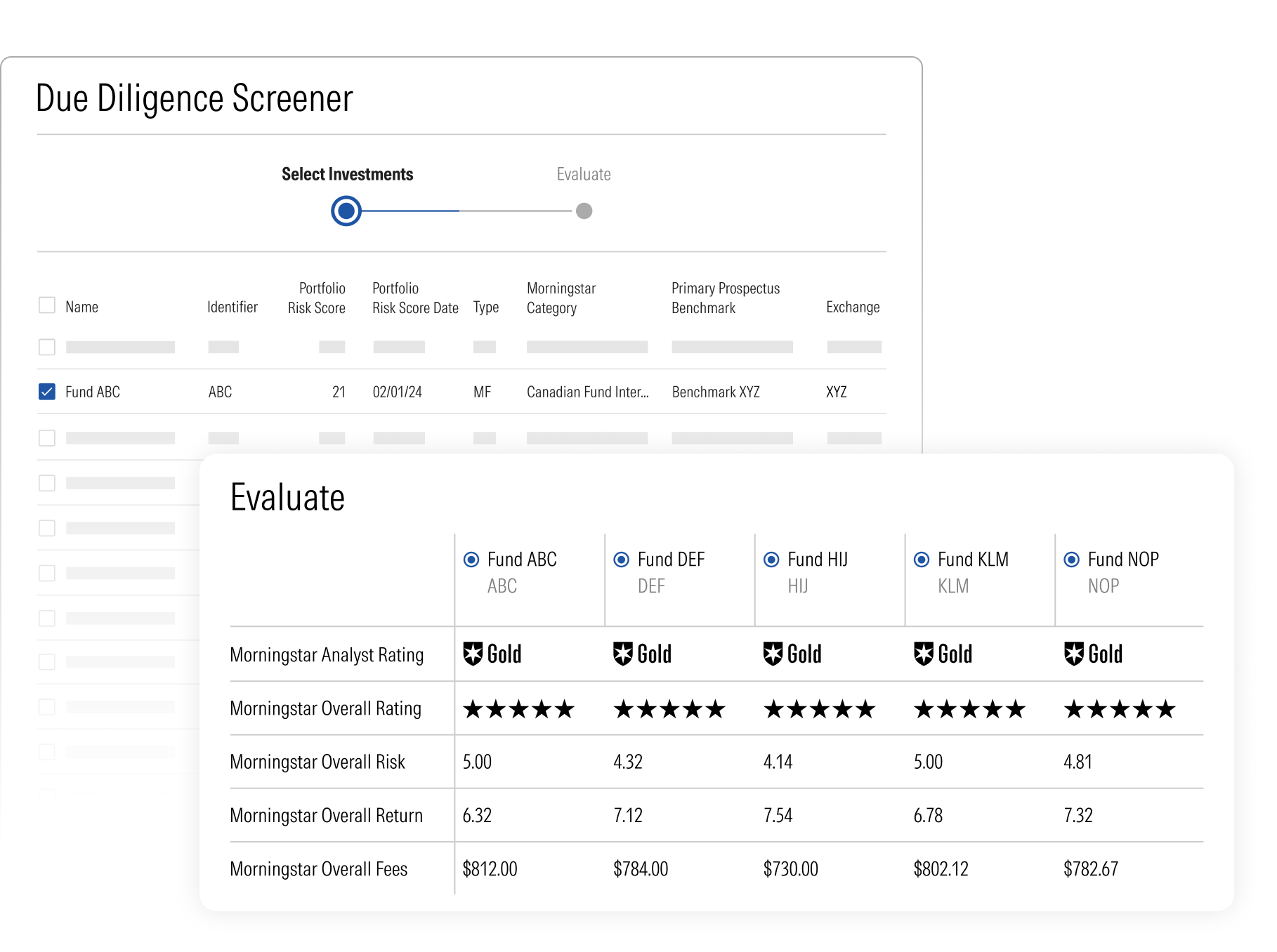
The Due Diligence Module within Direct Advisory Suite can be configured to require advisor notes when comparing a reasonable range of alternatives, creating a timestamped review trail. Metadata from these reports can be sent to a firm compliance system or viewed within Morningstar’s Enterprise Analytics at the firm level for oversight.
Deficiency identified: Inadequate evidence that registered individuals performed their own KYP; Improper reliance on affiliate or manufacturer KYP
Regulatory requirements:
- NI 31-103 13.2.1(2) requires individuals to understand securities they recommend.
- NI 31-103 13.2.1(1)(a) requires independent assessment.
Ideal behaviors:
- Provide advisors access to KYP materials and document personal review.
- Conduct firm-level KYP assessments.
How Morningstar helps
Morningstar has a long pedigree of maintaining high-quality managed investment data in Canada. As opposed to relying on wholesaler-provided info, reports from Morningstar Direct Advisory Suite are free from bias and aim to help with Morningstar’s Mission to empower investors. Performance, risk and other qualitative data are made comparable across manufacturers and measured against Canadian industry-standard peer groups.
Additionally, advisors can rely on Morningstar’s trusted research and ratings, written in plain language and with transparent methodology, to offer truly independent insights regarding the merits of a managed investment, or individual security. We note that this research includes a written assessment of an asset manager’s stewardship qualities and historical track record (expressed as a “Parent” rating within the Morningstar Medalist Rating framework).
Additionally, advisors can rely on Morningstar’s trusted research and ratings, written in plain language and with transparent methodology, to offer truly independent insights regarding the merits of a managed investment, or individual security. We note that this research includes a written assessment of an asset manager’s stewardship qualities and historical track record (expressed as a “Parent” rating within the Morningstar Medalist Rating framework).
Deficiency identified: No KYP on transferred-in or client-directed securities
Regulatory requirement: NI 31-103 13.2.1(1)(a) and (c) require assessment and monitoring.
Ideal behavior: Conduct KYP within a reasonable time and include securities in monitoring processes.
How Morningstar helps
Morningstar’s deep database covers performance, risk, fee, and operational information across 22,000 Canadian-domiciled Mutual Funds and 1900 Canadian-listed ETFs, alongside fundamental equity data on 98% of global market cap.
Suitability Determination
Suitability is where client information and product understanding intersect. CIRO found many firms still assess suitability at the transaction level rather than from a portfolio or household perspective.
Deficiency identified: No process to aggregate holdings across multiple accounts
Regulatory requirement: NI 31-103 13.3(1)(b) requires putting the client’s interest first using a holistic view.
Ideal behavior: Aggregate holdings and assess risk across all client accounts.
How Morningstar helps
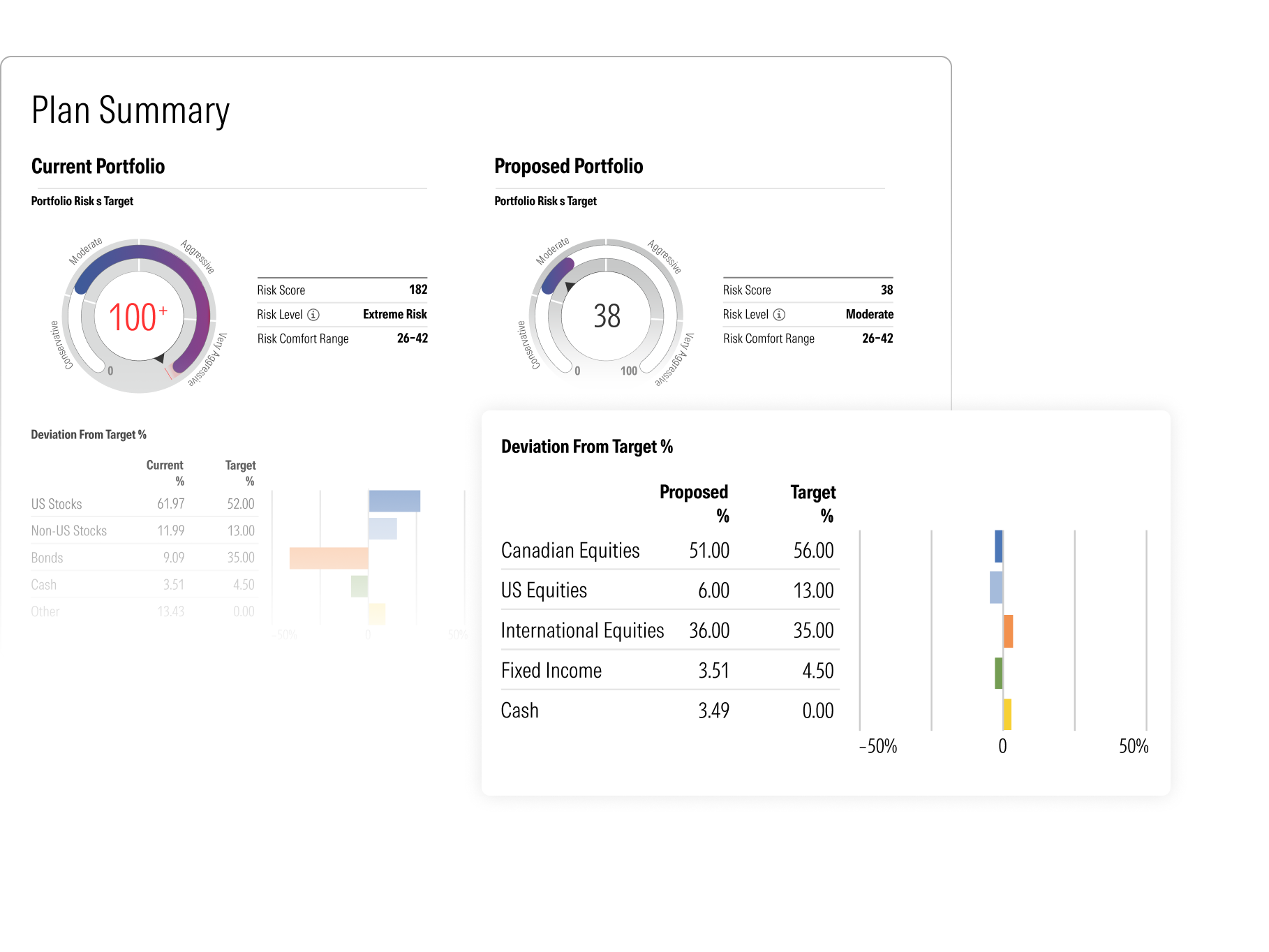
Direct Advisory Suite provides household-level views of portfolios and overall risk.
Deficiency identified: No meaningful consideration of costs, including series selection and fee differences
Regulatory requirement: NI 31-103 13.3(1)(a)(iv) requires consideration of cost impact.
Ideal behavior: Assess direct and indirect costs and consider lower-cost alternatives.
How Morningstar helps
Morningstar’s database embeds fee data into ratings, rankings. Morningstar’s Fee Level methodology, enabling apples-to-apples cost comparisons. Fees are also surfaced prominently in the Due Diligence Module, designed specifically to aide with comparison to a reasonable range of alternatives.
.svg)
Deficiency identified: No documentation of a reasonable range of alternatives
Regulatory requirement: NI 31-103 13.3(1)(a)(v) requires consideration of reasonable alternatives.
Ideal behavior: Identify comparable alternatives and document rationale.
How Morningstar helps
The Due Diligence Module within Direct Advisory Suite explicitly supports the consideration of a reasonable range of alternatives, with Enterprise Analytics providing firm-level oversight.
Ensuring Value for the Future
CIRO’s updated guidance confirms that the bar for advice in Canada has permanently risen. KYC, KYP, and suitability are no longer isolated obligations, but interconnected processes that must collectively support client-first outcomes.
Firms that treat the CFRs as a compliance minimum risk missing the larger opportunity. When implemented thoughtfully, the CFR framework aligns naturally with what today’s investors expect: transparency, consistency, and clear reasoning behind each recommendation.
Morningstar Direct Advisory Suite helps firms operationalize these expectations through independent research, robust analytics, and scalable workflows. In doing so, it supports advisors in delivering higher-value advice that stands up to regulatory scrutiny and remains competitive in an increasingly transparent marketplace.