
Personalization at Scale: The Competitive Edge Asset and Wealth Management Firms Can't Ignore

For years, personalization has been a priority across financial services. Clients, advisors, and investors have always responded to experiences that feel relevant to their goals, challenges, and preferences. What's changed is the scale of that expectation.
Morningstar's 2025 Voice of the Asset Manager research report shows just how quickly advisor expectations are evolving. Personalized communication ranked third on the list, making it a high priority for clients. And while investment performance remains an important driver of value, asset managers reported increasing advisor demand for digital tools and platforms (67%), access to alternatives (65%), and model portfolio solutions (59%) compared with three years ago. Advisors are increasingly looking beyond products alone and expecting experiences that are easier, more relevant, and better aligned with their needs.
Three-year change in advisor demand
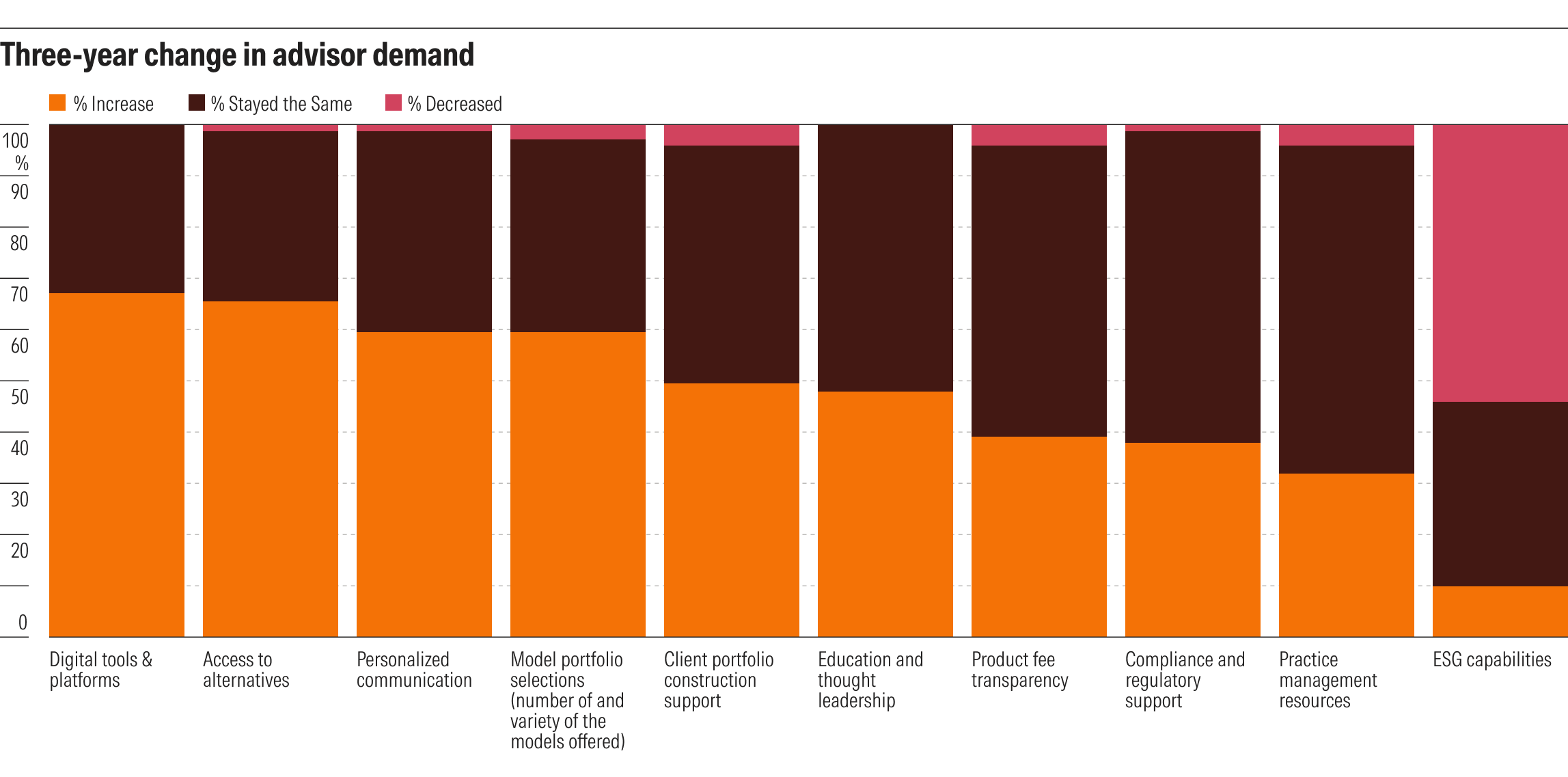
Source: Morningstar Voice of the Asset Manager 2025 survey.
The research also revealed an important disconnect: While asset managers ranked thought leadership and industry expertise as a key source of value, advisors were more likely to cite ease of doing business. That gap suggests firms have an opportunity to rethink how they engage advisors—not just what they communicate, but how they deliver those experiences.
For heads of marketing, sales, and distribution, personalization has evolved from a marketing tactic into a strategic growth lever. In a market where products can appear increasingly similar, the quality and relevance of engagement often become meaningful differentiators. Firms that consistently deliver the right insights to the right audience at the right time are more likely to earn trust, strengthen relationships, and stay top of mind.
Relevance Is the New Measure of Value
The value asset managers provide advisors has always extended beyond investment products, but advisor expectations continue to evolve.
Morningstar's research found that advisors and asset managers largely agree that investment performance remains important to their relationship. However, advisors increasingly expect firms to deliver more than performance updates. Rising demand for personalized communication, digital engagement capabilities, and broader support services reflects a shift toward more holistic relationships.
At the same time, the industry is experiencing a generational shift. As wealth transfers to younger investors, firms are increasingly serving clients whose expectations have been shaped by highly personalized digital experiences. These investors often expect communication, reporting, and investment solutions that reflect not only their financial objectives but also their personal preferences and values.
The result is a growing expectation for relevance across every touchpoint. For wealth management firms, that may mean proactive outreach tailored to a client's life stage, goals, or changing circumstances. For asset managers, it may mean delivering advisor-ready insights that align with an advisor's investment focus, business model, or client base rather than relying on broad product-centric messaging.
For marketing leaders, the challenge is clear: How do you create engagement that feels personal while reaching thousands of investors and advisors efficiently?
Why Personalization Remains So Difficult
If personalization is so important, why do so many firms struggle to deliver it consistently?
The answer isn't a lack of data. In many cases, it's the opposite.
Asset and wealth management firms have access to more information than ever before. Client data, advisor interactions, marketing engagement, website activity, sales intelligence, and portfolio insights all provide valuable signals.
The challenge is that these signals often sit in disconnected systems. Without a unified view of relationships, marketers, sales teams, and distribution leaders may struggle to understand audience needs or identify the next best action.
As organizations grow, fragmentation becomes increasingly difficult to manage. Teams spend valuable time piecing together information instead of acting on it.
Insights Don't Always Lead to Action
Many firms can generate reports, dashboards, and analytics. Turning those insights into meaningful engagement is often where things break down.
The issue isn't whether data exists. It's whether teams know how to use it.
Without clear signals and actionable guidance, marketers may struggle to deliver relevant content, sales teams may focus attention on the wrong opportunities, and advisors may miss timely information that could help them better serve clients.
As a result, valuable insights often remain trapped in systems rather than driving better outcomes.
Traditional Operating Models Don't Scale
Historically, personalization has depended heavily on individual relationships. Advisors remembered client preferences, marketers segmented audiences manually, and sales teams relied on personal knowledge to tailor outreach.
While effective on a small scale, that approach becomes difficult to sustain as firms expand.
Delivering personalized experiences consistently requires operational models that help teams act on insights efficiently and at scale – not simply work harder.
What Personalization Looks Like in Practice
Personalization is often discussed as a broad concept, but its value becomes much clearer when viewed through real-world outcomes.
At its core, personalization helps firms move from generic experiences to intelligent engagement.
More Relevant Communication
Personalized engagement starts with understanding what matters most to a specific audience and delivering content that reflects those interests.
In asset management, this is especially important. Advisors are inundated with market commentary, product information, educational content, and sales outreach. The firms that break through are often those that connect advisors with insights that are relevant to their clients, portfolios, and business objectives.
Rather than simply increasing communication volume, effective personalization improves communication quality.
More Proactive Engagement
Personalization also enables firms to anticipate needs rather than simply react to them.
Organizations such as United Advisors America have demonstrated the value of using technology and data-driven insights to better support advisor engagement and create more meaningful interactions. By identifying opportunities and surfacing relevant insights at the right time, firms can focus their efforts on conversations that are most likely to create value.
This shift helps organizations answer three important questions: Who should we engage? When should we engage them? And why does the interaction matter?
More Adaptive Experiences
Personalization extends beyond communication. It also shapes the overall experience firms deliver.
As organizations scale, maintaining consistency across communications, reporting, and advisor experiences becomes increasingly challenging. Sanlam Investment Management Proprietary Limited (SIM), for example, was growing rapidly and needed their reporting to keep up.
Having the customizable report options in Direct allowed them to adapt quicker and easier. By reducing fragmentation and creating more unified, personalized experiences, firms can make interactions feel more relevant and seamless for end users.
The goal is not to create a unique process for every individual. It's to build experiences that can adapt based on preferences, behaviors, and needs – whether through reporting, communication cadence, digital experiences, or content delivery.
Why It Matters Now
Personalization is often viewed as a customer experience initiative. Increasingly, however, it is becoming a competitive strategy.
Morningstar's research found that distribution and asset gathering remain the biggest challenge facing asset managers today, with 52% identifying them as their primary obstacle. At the same time, firms report increased competition from passive and low-cost products, pressure on distribution channels, and growing expectations from advisors.
The same research suggests that the firms best positioned for future growth will be those that move beyond product-centric interactions to deliver personalized, holistic solutions that reflect clients' and advisors' evolving goals and expectations.
In that environment, relevance becomes a growth enabler.
For wealth managers, personalized engagement can strengthen client relationships, improve retention, increase wallet share, and generate referrals.
For asset managers, it can deepen advisor relationships, improve outreach effectiveness, support distribution efforts, and create more productive sales conversations.
Perhaps most importantly, personalization helps firms create stronger connections in a landscape where attention is increasingly fragmented, and expectations continue to rise.
The firms that gain an edge will not necessarily be those with the most data. They will be the ones that can transform data into meaningful action—delivering timely insights, tailored experiences, and stronger relationships at scale.
As firms explore answers to this challenge, they should consider how connected data, actionable insights, and scalable engagement strategies can help transform personalization from an aspiration into a competitive advantage. Learn more about how Morningstar helps marketers with solutions to create more relevant engagement across the investor journey.