
5 min read
What Are the Top Asset Management Trends Shaping the Industry?
Traditional asset managers continue to struggle compared to their alternative asset manager peers.

Key Takeaways
- Low-cost passive competition and weak relative fund performance are limiting organic AUM growth for traditional asset managers compared to alternative asset managers.
- Alternative asset managers haven’t witnessed as much pressure on base management fees as the traditional asset managers have experienced from the rise of passive products.
- Traditional asset managers face operating profitability challenges while alternative asset managers benefit from the growth of perpetual capital.
As the financial landscape evolves, so do the challenges and opportunities for asset managers. While traditional asset managers face ongoing obstacles with outflows and fee pressure, alternative asset managers are cautiously navigating market uncertainty and enjoying growth driven by demand for alternative investment opportunities.
When you’re up to date on the latest asset management trends, it can improve your ability to make better investment decisions. Our Morningstar researchers take an in-depth look at the traditional and alternative asset management spaces, market conditions, future outlooks, top industry picks, and more.
Alternatives Benefit From Strong Demand
Even though traditional asset managers face numerous ongoing obstacles, alternative asset managers are experiencing a different reality. Our latest Q4 2025 Asset Manager Pulse report demonstrates that the latter group continues to benefit from a demand tailwind that has seen its total assets under management rise from $1.6 trillion at the end of 2005 to an expected $17.7 trillion at the end of 2025. Although organic AUM growth—net flows into long-term managed assets divided by beginning of period long-term AUM—will likely slow, we expect to see the industry sitting on an estimated $27.2 trillion in total AUM at the end of 2034.
For traditional asset managers, low-cost passive competition and weak relative fund performance have limited organic AUM growth. Only BlackRock and Invesco generated higher organic AUM growth over the past five years than their traditional asset-management peers, primarily due to their passive product offerings. Meanwhile, T. Rowe Price and Franklin Resources have been perennial underperformers, creating consistently negative organic AUM growth during 2021-25.

BlackRock and Invesco have generated better organic AUM growth than their peers over the past several years.
Our 2025 US Asset Management Industry report highlights BlackRock and Blackstone as "best-in-class" operators for both traditional and alternative asset management industries. This is highlighted by their ability to generate above-average levels of organic AUM growth and operating margins, while others struggle with one or both of those attributes. We expect the market to continue to reward firms that can consistently generate these two attributes with higher trading multiples (of 20 to 40 times forward earnings) relative to their less-fortunate peers in the two groups.
What can all asset managers do?
- Incorporate alternatives through approaches such as separately managed accounts
- Embrace the convergence of public and private investments via opportunities in private equity and private credit
- Adopt AI to help scale workflows and processes
Passive Products Add Fee Pressure
Over the past two decades, the alternative asset managers haven’t witnessed as much pressure on base management fees as the traditional asset managers have experienced from the rise of passive products. More specifically, private credit growth has helped reverse the percentage of lower cost funds, based on data provided by PitchBook. Carry fees have also recovered since the global financial crisis with most rated funds holding rates at/above 20% the past decade.

Management fee rates for private capital funds have eroded in the past decade.
Meanwhile, active fund fees for the traditional asset managers continue to be pressured, making a larger impact on these firms compared to the alternative asset managers. In fact, average asset-weighted expense ratios for active funds have dropped below 60 basis points as base management fees continue to be pressured by the growth of low-cost passive products and more stringent retail distribution platforms. We expect fee compression to persist longer term, driven by the growth of low-cost funds and ongoing fee reductions to maintain placement on retail platforms.
What can all asset managers do?
- Consider innovative pricing models like performance-based or hybrid fee structures
- Focus on differentiation by offering strategies rooted in proprietary research or niche exposures
- Lean into a technology-first approach by using advanced data, analytics, and personalized tools
Revenue Compression Persists for Traditional Asset Managers
Both secular and cyclical headwinds will persist for most of the traditional asset managers. While it took some time for sales to recover, most firms are now on pace to generate annual revenue above what was seen prior to the Federal Reserve tightening phase in 2022-23. With passive growth continuing to have an impact on active manager flows and fees under pressure, we expect revenue growth to be somewhat muted over the next 10 years.
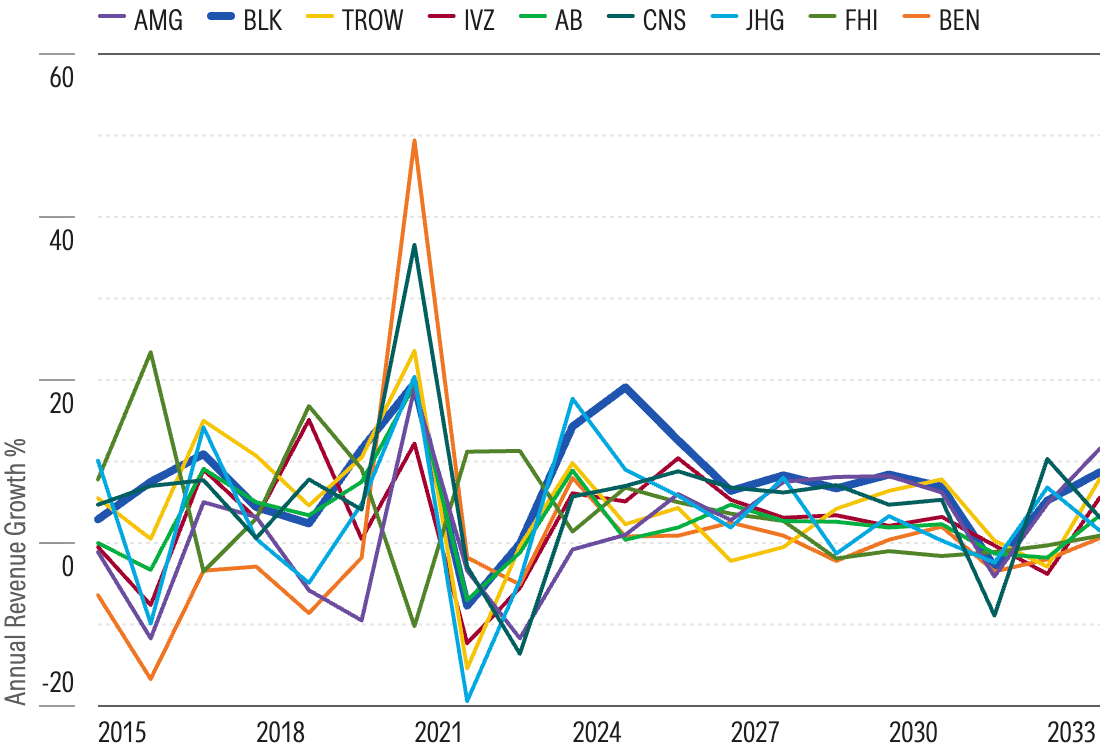
Revenue growth should continue to trend higher for traditional asset managers.
Revenue growth for alternative asset managers declined during 2022-23, primarily due to lower unrealized performance allocations and changes in principal investments. While most firms’ top lines rose in 2024 and during the first half of 2025, increased uncertainty tied to fiscal, tariff, and monetary policies—as well as economic growth—are expected to temper near-term results. Future top-line results, including contributions from unrealized and realized performance allocations, hinge on the state of the economy and market environments.
What can all asset managers do?
- Incorporate new vehicle structures like exchange-traded funds into offerings
- Adapt technological advancements to help manage risk and maximize alpha generation
- Find partners who embed AI throughout their ecosystem
Perpetual Capital Helps Alternative Asset Managers
On the alternative asset-management side of things, perpetual capital—funds with no fixed end date—can generate steady long-term revenue streams for firms. Movement into these types of funds have led most alternative managers to focus on fee-related earnings, a performance measure used by the industry to assess the ability of firms to generate profits from revenue measured and received on a recurring basis and not subject to future realization events. As a result, FRE margins have been expanding as alternative managers shift increasingly toward perpetual capital.
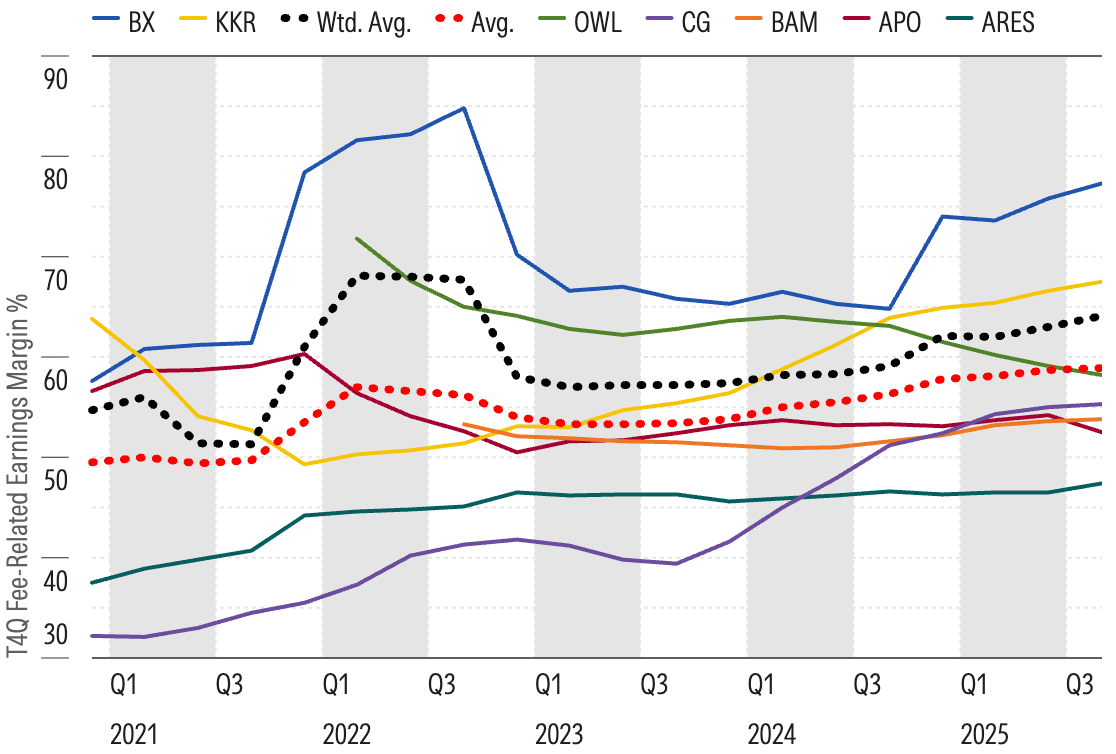
Margins on fee-related earnings are expanding with the rise in perpetual capital for alternative asset managers.
Even though the traditional asset managers have reduced some of their fixed costs since the 2008-09 financial crisis, there’s still a fair amount of operating leverage in their business models—serving as a double-edged sword during down markets. BlackRock’s larger scale and focus on passive products has allowed the firm to keep its adjusted operating margins at/above 40%, providing the company with far more capital than its traditional asset-management peers to reinvest back into the business.
What can all asset managers do?
- Utilize AI to help improve margins and reduce operating costs
- Explore diversification into new asset classes and/or channels
- Leverage technology-driven operational models
Deliver High-Quality Offerings Backed by Trusted Data
In a constantly changing asset management industry, it’s important for asset managers to stay ahead and demonstrate their value. By knowing the latest trends, you can better support your clients.
Gain a competitive edge with Morningstar Direct. The comprehensive platform lets you build assets, manage portfolios, and show how your data-backed recommendations align with investor goals.


