
5 min read
Fund Fee Wars Shift to Complex Funds and New Strategies

Key Takeaways
- Investors saved an estimated $6.8 billion in fund expenses last year.
- The economics of the advice business is shaping flows and fees. Fee-based advisors prefer unbundled funds as they make room for the price of advice.
- The fee gap between new mutual funds and new ETFs has narrowed for years but widened in 2025.
Investors paid lower fund expenses in 2025 than ever before.
In 2025, the average expense ratio paid by fund investors was less than half what it was two decades ago. Between 2006 and 2025, the asset-weighted average fee fell to 0.32% from 0.80%. As a result, investors have saved billions in fund fees.
Three factors played a role in lowering fees:
- Investors are increasingly aware of the importance of minimizing investment costs, which has led them to heavily favor lower-cost funds.
- Competition among asset managers has led many to cut fees.
- The move toward fee-based models of charging for financial advice has fueled the shift toward lower-cost funds.
Fund fees are not following a straight line down, however. While fees of prominent index mutual funds and ETFs are approaching a floor, new active ETFs and alternative strategies come with higher price tags.
These are some of the insights from the latest US Fund Fee Study published by the Morningstar Manager Research team.
Get the Full Report
What's inside:
- A breakdown of fee trends by investors, industry, and investment vehicle
- An overview of how fund companies are competing
- Analysis of how the economics of the advice business shape fund flows and fund fees
Trends in ETF and Mutual Fund Expense Ratios
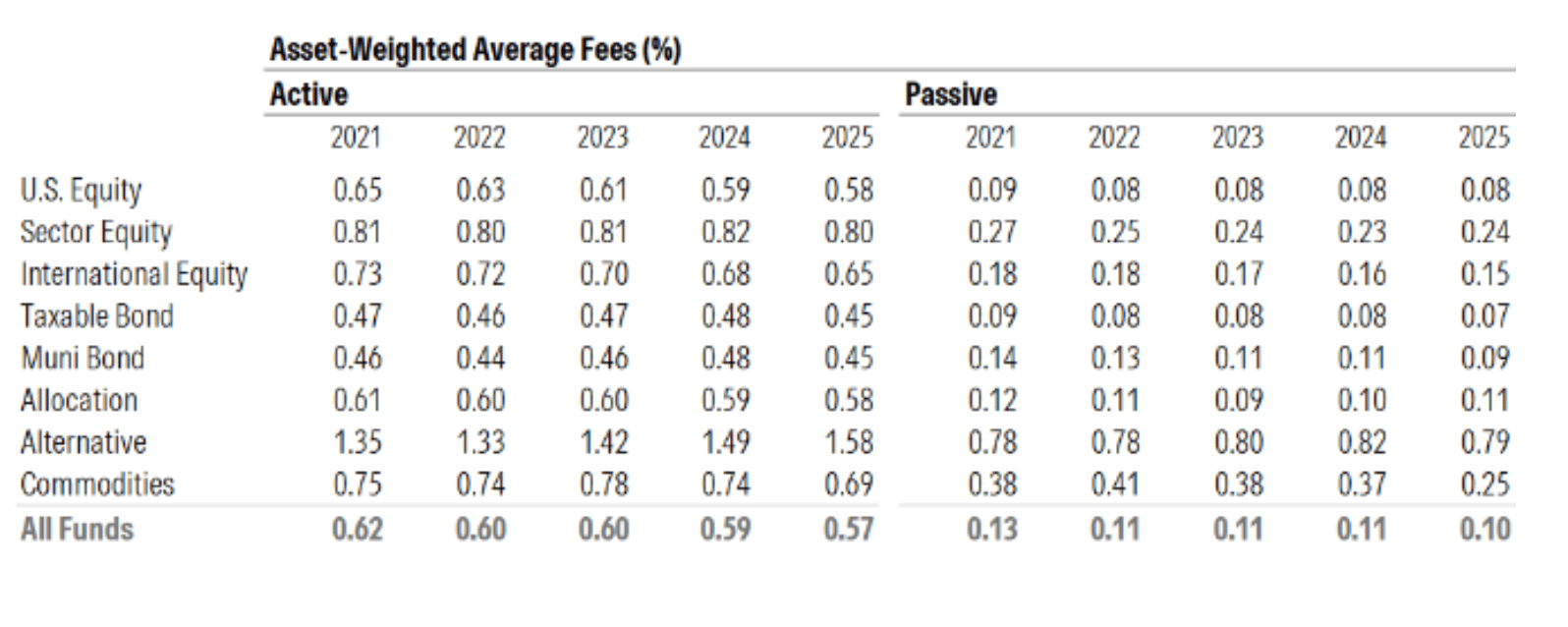
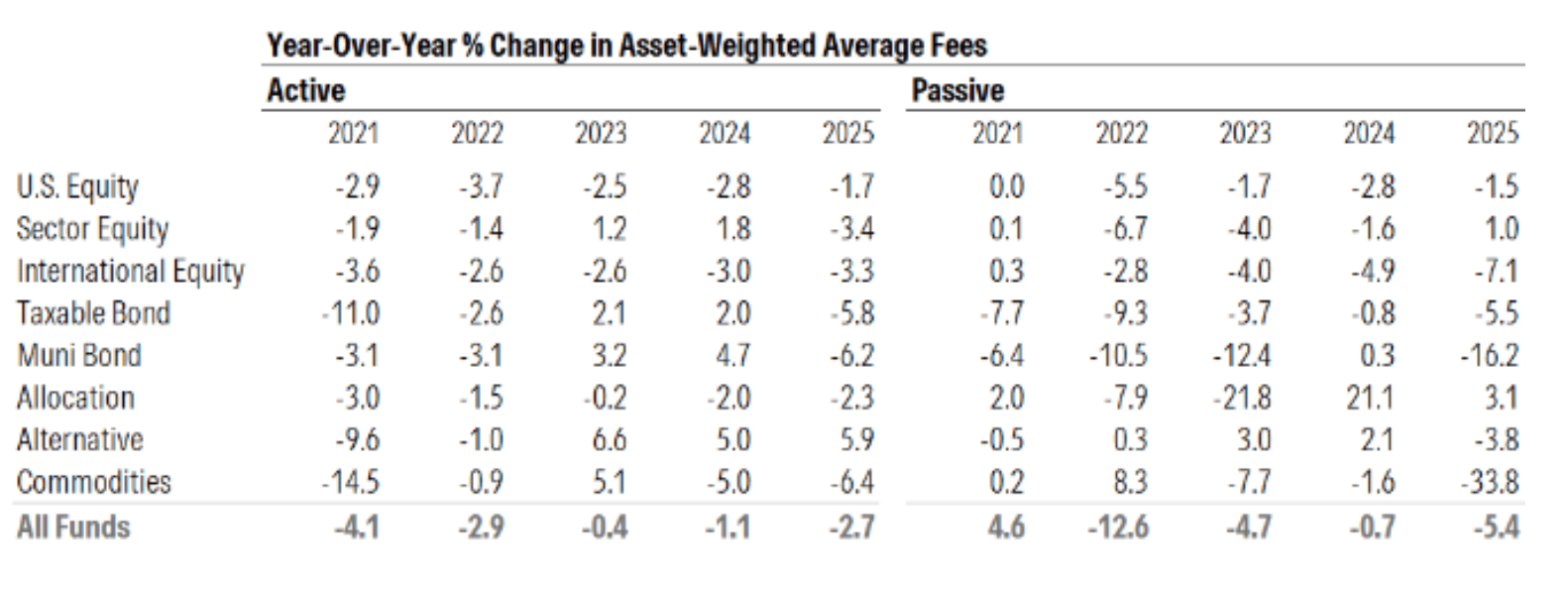
Declines in asset-weighted average fees accelerated in 2025. Asset-weighted expense ratios declined 2.7% for active funds and 5.4% for passive funds in 2025.
Lower asset-weighted fees are possible thanks to a combination of inflows into low-cost funds, outflows from more costly ones, fee cuts, and relative underperformance by more-expensive funds.
The Basics of Fund Fees ft. Zach Evens
We examined the trend in fund expenses using the asset-weighted average expense ratio. The asset-weighted average better represents the average costs borne by fund investors than an equal-weighted average because it approximates what investors paid rather than what funds charged.
ETFs are no longer synonymous with low cost, and product selection now requires deeper scrutiny. In 2025, the average fee for new funds climbed to its highest level in a decade, with new mutual fund fees topping 1.00% for the first time since 2015.
As asset managers roll out more complex and differentiated strategies in both ETF and mutual fund wrappers, evaluating cost in isolation is no longer enough. Advisors must assess whether these newer, often higher-cost offerings deliver meaningful diversification, improved risk management, or alpha potential that outweighs their expense.
Investors' Average Fund Costs by Asset-Weighted Average Fees
Source: Morningstar Direct. Data as of Dec. 31, 2025.
Passive Funds’ Average Fees Fell Further Than Active Ones
Source: Morningstar. Data as of Dec. 31, 2025
Mutual Fund Fees Are on Their Way to Matching ETF Fees
The average ETF fee measures around half of the fee charged by mutual funds. However, this gap has narrowed over time.
On the passive side, gold’s outstanding run in 2025 saw investors rushing to buy relatively inexpensive funds that track the price of gold or the gold industry. This pushed the asset-weighted average fee of the commodities super sector down by over a third from the year prior.
On the active side, alternative strategies have bucked the broader trend of fee declines and have seen asset-weighted fee increases in each of the last three years. This reflects both the proliferation of relatively higher cost alternative funds and instances where investors are willing to pay up for complex products.
Alternative strategies have seen fee increases for three consecutive years, bucking the broader trend.
Expensive Leveraged Equity Funds Dominated Launches in 2025
Trading -- Leveraged Equity fund launches in 2025 charged an average fee of 1.17%. That’s roughly double what new funds in more traditional categories, like Large Blend, charged.
These funds tend to charge higher fees than more traditional, diversified stock or bond funds, and they are generally not meant for long-term investors.
As fees and profits get squeezed, the proliferation of higher cost offerings is only natural.
While the strategies may be useful to some investors in specific circumstances, advisors should weight the cost of ownership against the outcome delivered.
Strategic-Beta Funds Are an Alternative to Pricey Active Funds
Strategic-beta funds attempt to marry the best attributes of active and passive approaches to portfolio construction. The indexes that underpin these funds attempt to codify strategies similar to those plied by active managers and deliver them in a format that is more transparent and less costly relative to most traditional actively managed funds.
At 0.16%, strategic-beta funds’ asset-weighted average fee is significantly lower relative to active funds (0.57%) but reflects a premium versus their peers tracking more traditional indexes (0.09%).
That said, this premium has narrowed in recent years as fee competition has spilled over from the realm of traditional index funds into strategic-beta funds.
Industry Competition and the New Fee War Battleground
For years, providers of broad market index funds have been engaged in what has been dubbed a “fee war.” In September 2018, fee fighting reached what seemed at the time to be its inevitable conclusion when Fidelity launched its lineup of zero-fee index mutual funds. More recently, other asset managers have followed suit.
As fees for these funds sit either at or near zero, the pace of fee declines will inevitably slow, prompting asset managers to look elsewhere for profits.
Fees of prominent index mutual funds and ETFs are approaching a floor, with many already charging less than 0.05%. As fees for these funds sit either at or near zero, it is inevitable that the pace of fee reductions will slow, prompting asset managers to look elsewhere for profits.
The fee battlefield has shifted away from commoditized asset classes and towards relatively newer and more complex investment strategies and funds.
How Fund Fees Are Shaped by the Economics of Advice
The evolution of the advice business is doing more than lowering fund fees—it’s reshaping how advisors demonstrate their value. As the industry moves away from transaction-driven compensation and toward fee-based models, investors are increasingly choosing lower-cost funds and share classes that carry fewer embedded distribution or advice costs.
The service-fee arrangement attribute in our US funds database is a useful means of beginning to understand what investors are getting in return for the fund fees.
The definitions of these groups are as follows:
- Unbundled: An investor simply pays for investment management and fund operating expenses, and the fund and its advisor do not pay third parties who sell their funds to the public. Unbundled and semibundled structures separate the cost of the investment product from the cost of advice, making pricing more transparent.
- Semibundled: The product charges no traditional distribution fees (or 12b-1 fees) or load-sharing but can have revenue-sharing or subtransfer agency fees. Semibundled structures remove traditional distribution fees but may still include some indirect payments. By contrast, bundled share classes incorporate advice and distribution costs into the fund’s expense ratio.
- Bundled: These are traditional share classes, where the investor pays a load and a 12b-1 fee to the mutual fund, which in turn pays the intermediary. Bundled share classes are purely transactional. Advice associated with these share classes may ultimately cost less.
As more assets migrate into unbundled and semibundled funds, the cost of advice becomes more explicit rather than embedded in fund fees. That transparency can benefit fee-based advisors, but it also shifts the conversation. At the same time, the long-term decline in fees across all service-fee arrangements underscores the growing commoditization of investment products.
All three service-fee arrangements have seen significant asset-weighted average fee declines over the past 20 years. Bundled funds are still the most expensive, as their expense ratio covers much more than just a fund’s management fee and operating expense, but their asset-weighted average total expense still dropped by 27%.
Meanwhile, the asset-weighted average fees for semibundled and unbundled funds were more than cut in half since 2005. This again highlights greater investor interest in low-cost products.
The Enduring Predictive Power of Fees
Cost remains one of the most reliable predictors of fund success. Lower-cost funds tend to outperform and survive at higher rates than their more expensive peers, largely because fees are certain, persistent, and directly reduce investor returns.
Across asset classes, the cheapest funds generally delivered higher success ratios and stronger long-term outcomes than the most expensive options. While factors like manager skill and investment process still play a role, cost remains one of the clearest and most dependable signals for investors seeking better outcomes.