
5 min read
Morningstar Parent Ratings: Key Traits of Top Asset Management Firms
Behind the most compelling funds are strong firms that attract talent and shape investment culture.

Key Takeaways
- Morningstar’s Parent rating keys in on an asset manager's investment culture and commercial practices.
- Like the other pillars of the Morningstar Medalist Rating, the Parent rating falls on a five-point scale: High, Above Average, Average, Below Average, and Low.
- Morningstar Data + Analytics offers trusted data on a firm’s stability, fee philosophy, investment performance, and more.
What do the best asset managers have in common? Morningstar’s Parent rating, a core pillar of the Morningstar Medalist Rating, evaluates the extent to which a firm creates an environment where funds can succeed over the long term.
By understanding the top traits of highly rated asset managers, clients can make informed investment decisions. With more than 200 Parent ratings published in 2025, our latest report breaks down the framework analysts follow to determine Parent ratings, the distribution of ratings across covered firms, and the relationship between key Parent metrics and subsequent performance.
To read the full research report, download a copy.
What Are Parent Ratings?
Morningstar's Parent rating takes a holistic and global view of how a firm cultivates, maintains, and advances two distinct but overlapping elements: investment culture and commercial practice.
A firm's investment culture includes its ability to attract, develop, and retain talent. The best firms nurture talented portfolio managers and analysts and plan transitions well in advance. Good parents pay their investors in ways that align their interests with fundholders and encourage managers to invest their own money in the strategies they run.
Commercial practices include the less flashy elements of running an asset management business, such as product development, distribution, fees, and day-to-day operations. These functions are easy to overlook but critically important to investors' experiences.
How a firm's investment and commercial cultures mesh determines most of the Parent rating, but regulatory issues can also ding a firm's score.
How Is the Parent Pillar Rating Distributed?
Among firms covered by Morningstar analysts, the distribution of Parent ratings skews higher, but sorts well. This is in part attributable to Morningstar's effort to cover the strongest asset managers and results in positive selection bias.
Like the other pillars of the Morningstar Medalist Rating, the Parent rating falls on a five-point scale: High, Above Average, Average, Below Average, and Low.
Here’s a breakdown of the ratings:
High: While not perfect, these firms set standards for other firms to emulate, such as consistently cultivating strong investment teams, being more affordable than the competition, or developing a lineup of sound building blocks for well-balanced portfolios.
Above average: These firms have some flaws but typically offer strong strategies and take sensible approaches to succession planning, fees, and product development.
Average: Considered to be industry standard, the overall quality of these firms' offerings can be inconsistent, but they may still offer strategies that earn higher Medalist Ratings.
Below average: While these firms may have a few compelling strategies, they tend to muddy lineups with expensive choices or struggle with succession planning.
Low: These firms have such severe operational issues or poor fund management approaches that it's difficult to muster the conviction they will last for the long term—and they often don't.
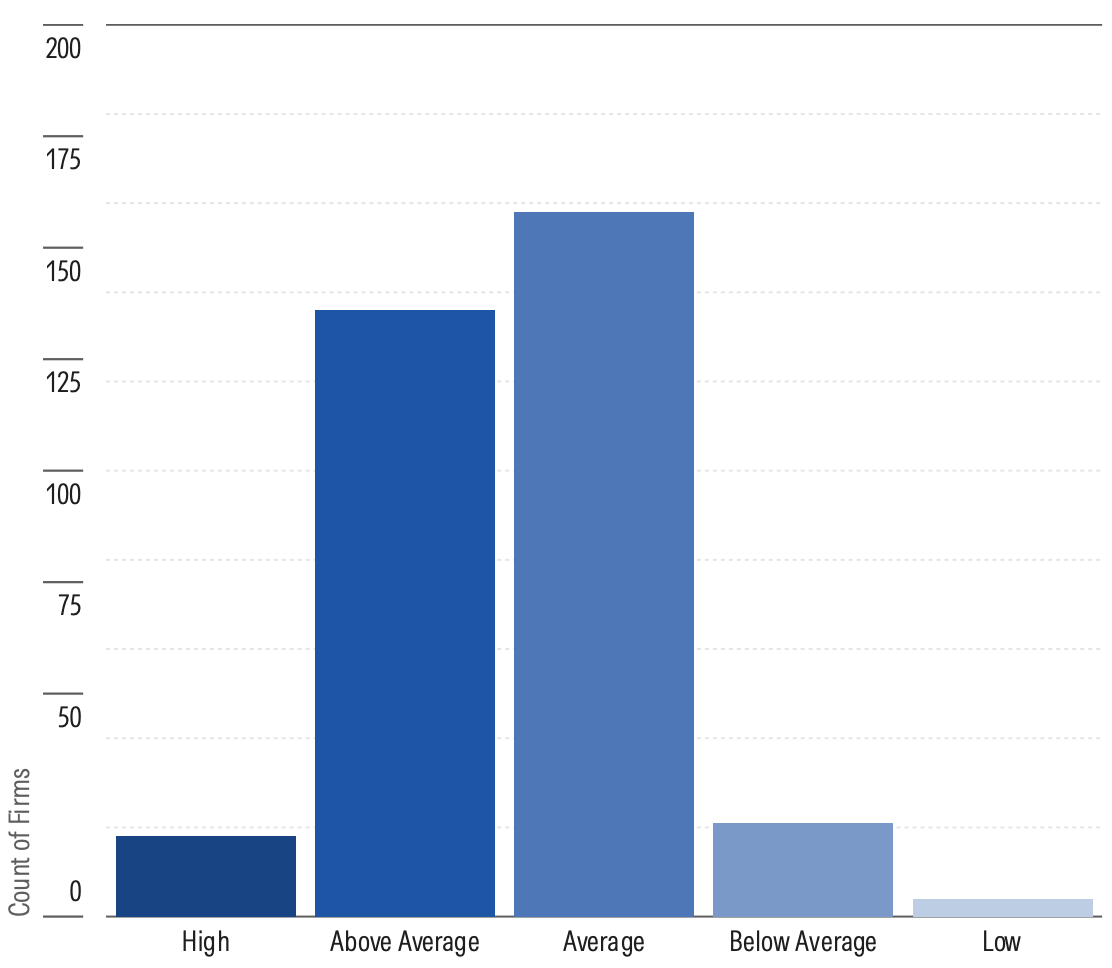
Just over half the firms Morningstar analysts cover earn Average Parent ratings.
Common Characteristics of Highly Rated Firms
Strong firms boast experienced managers
To evaluate a firm's ability to attract and develop talented portfolio managers, Morningstar analysts examine its managers' fund, firm, and career tenures. Among firms under analyst coverage, those with higher Parent ratings have more-experienced portfolio managers. High and Above Average firms, whether boutiques or conglomerates, offer financial incentives and cultural benefits that attract and retain talent.
Long tenures don't always indicate excellence—some firms allow chronic underperformers to scrape by for years. Still, portfolio managers who have invested through full market cycles often offer insights, wisdom, and mastery that less experienced managers have yet to acquire.
Successful parent firms charge low fees
Strong stewards keep fund fees competitive, and higher-rated firms usually offer better deals. Yet, there are exceptions: Many of High-rated Boston Trust Walden’s fund share classes have above-average expenses, in part because its funds tend to target smaller stocks and are capacity-constrained, which often prompts the firm to limit their asset growth and its ability to pass economies of scale to investors. With less than USD 5 billion in assets under management (as of December 2025), the firm is smaller than most High-rated parents. Meanwhile, Vanguard’s enormous size and unique mutual ownership structure help it offer rock-bottom fees. Capital Group’s large asset base also keeps it among the cheapest active managers.
Most firms under coverage, even those with Average or Below Average ratings, offer better deals than the industry average. Many Below Average parents provide inexpensive passive and systematic strategies, but their ratings suffer on account of poor governance or a preponderance of gimmicky funds.
Highly rated parents have strong track records
Success is rare in the industry. Just 30% of firms have winning lineups, or those in which more than half of funds survived and outperformed peers over the past 10 years.
Many of the winners are under Morningstar analyst coverage, and the High and Above Average parents of 2025 have performed well. The few covered firms that trailed peers are fundamental equity boutiques that have struggled in the momentum-led markets of recent years.
Average success ratios tend to decline in line with Parent ratings, with relatively few Average parents delivering risk-adjusted success ratios greater than 60% over the past 10 years, and no Below Average parents claiming that record.
Access Trusted, Morningstar-Backed Data
Understanding a firm’s Parent rating can help clients avoid investment risks and move forward with confidence.
With Morningstar Data + Analytics, you can get unparalleled data on a firm’s stability, performance, and more. The platform offers Morningstar Medalist ratings, metrics, and analytics to build strong portfolios.