5 min read
Client Expectations Are Shifting—How Marketing Leaders Can Align Messaging to Meet Demand
Clients invest in trust, expertise, and conviction more than a product. Does your messaging give them the push to say ‘Yes’ to you?

In a crowded market, differentiation for asset management firms comes down to how clearly and credibly a firm communicates its value — not just what it delivers.
There are thousands of asset management firms all trying to market the same high-value offerings to clients, like high return rates and products to make investing a more accessible avenue. Those goals are all well and good, but current and prospective clients aren’t only looking for product pushes and returns promises in your messaging. In fact, more often than not, they aren’t looking for what you have to offer, but why you’re the best person to be offering it.
Morningstar’s 2025 Voice of the Asset Manager study featured responses from 68 asset managers about what has become most important to their clients in an evolving market and the growing influence of AI. You can read the full report and understand more about how to differentiate your messaging in a way that speaks to clients.
Performance Still Matters—but It’s No Longer the Differentiator
The asset management industry is entering a new phase—one defined less by product performance alone and more by how effectively firms communicate value.
Performance remains the starting point of any investment conversation. But it is no longer the deciding factor.
While both asset managers (51%) and advisors (41%) continue to rank performance as a top driver of value, the competitive landscape has shifted. Clients now expect solutions that are more personalized, goal-oriented, and aligned to their broader portfolio needs—not just strong standalone returns.
To meet these expectations, firms need to move beyond performance-led messaging and clearly articulate:
- Their investment philosophy
- The sources of repeatable outcomes
- How risk is managed and controlled
Just as importantly, this information must be delivered in a way that resonates with advisors–through transparent, consistent, and easy-to-interpret narratives. Messaging that is overly technical or inconsistent can create friction, even when underlying performance is strong.
For a broader look at how these dynamics are reshaping the industry, read our related analysis on the 6 Asset Management Trends for Marketers.
Distribution Challenges Start with Positioning
Distribution remains one of the industry’s most persistent challenges—but the underlying issue is often positioning.
52% of asset managers cite distribution and asset gathering as their top obstacle. Key pressures include competition from passive and low-cost products (38%) and difficulty accessing key platforms and model portfolios (29%). In this environment, gaining traction is less about having the best-performing product and more about how clearly and credibly that strategy is positioned.
To compete effectively, firms need to align their messaging with how gatekeepers, platforms, and advisors evaluate strategies. That includes:
- Providing transparent and comparable data
- Clearly explaining investment approach and differentiation
- Framing strategies within the context of portfolio construction needs
Strong positioning turns complex strategies into clearly articulated stories—making it easier for decision-makers to allocate capital.
Advisors Want Ease of Doing Business—Your Messaging Should Reflect That
One of the most notable shifts highlighted in the research is the growing importance of usability.
While 32% of asset managers rank thought leadership and expertise highly, 26% of advisors place a higher premium on ease of doing business –including how simple it is to access information, use tools, and implement strategies at scale.
This has direct implications for marketing and messaging.
Firms should highlight:
- Operational efficiency and streamlined workflows
- Integration across research, data, and portfolio tools
- Support structures that help advisors save time and scale their business
In a competitive market, being easy to work with is not just a service advantage,–it becomes a core part of the value proposition.
Personalization and Digital Tools Are Now Expected
Advisor expectations are evolving rapidly, particularly when it comes to digital capabilities and personalization.
Over the past three years, demand has increased significantly for digital tools, model portfolios, and access to alternative investments–all of which point toward a more tailored approach to portfolio construction.
This shift challenges traditional marketing models built around broad-based campaigns. Instead, firms need to enable:
- Role-specific messaging for different types of advisors
- Content aligned to specific use cases and client needs
- Seamless integration between digital tools and communication
Personalization is no longer a differentiator; it’s the baseline expectation. Firms that fail to adapt risk falling behind in both relevance and engagement.
Alternatives Are Growing–But Education Is the Real Opportunity
Private markets continue to see rising interest, but they also introduce new layers of complexity.
More than 60% of asset managers expect client allocations to private investments to increase over the next 12 months, reflecting growing demand from both advisors and clients.
However, differentiation remains a challenging in a few primary ways:
- 30% cite standing out in an increasingly crowded market
- 25% cite navigating liquidity constraints
- 25% cite educating advisors and clients on role and suitability
This is where marketing can play a critical role.
Firms that invest in clear, accessible education–explaining not just what the strategy is, but how and why it fits into a portfolio–can build deeper trust and stronger engagement. In many cases, the ability to simplify the message becomes just as important as the strategy itself.
Clear, Simple Storytelling Wins in Complex Markets
As investment strategies become more sophisticated, the ability to communicate them simply becomes a competitive advantage.
Advisors face constant time constraints and information overload. As a result, even strong ideas can struggle to gain traction if they are not clearly articulated.
Effective messaging should:
- Distill complexity into a few core ideas
- Use structured, repeatable narratives
- Focus on outcomes and relevance, not just technical detail
Clarity enables advisors to quickly understand a strategy–and more importantly, explain it to clients. In a crowded market, that clarity is what drives adoption.
Position AI Tools as a Marketing Advantage
Generative AI is rapidly reshaping how asset managers operate–and how they present themselves to clients.
Many firms are already using AI to improve efficiency across research, communication, and internal workflows. But beyond operational gains, AI also represents a messaging opportunity. 55% of asset managers believe generative AI will transform the industry in the next three years.
Firms can differentiate by showing:
- How AI enhances insight and decision-making
- How it improves responsiveness and client service
- How governance and risk controls are managed responsibly
Positioned effectively, AI becomes more than a tool–it becomes part of the firm’s broader value proposition. The key is balancing innovation with transparency to build trust. And the proof is in the data. 53% of asset managers reported improved efficiency in day-to-day work, and 55% believe it will transform the industry in the next three years . The three most prevalent areas where AI is being leveraged are research, productivity, and communication. 64% of asset managers are likely or extremely likely to keep adding increased AI capabilities into their workflows within the next year.
How Morningstar Helps You Share Your Story
Performance remains essential, but it is no longer enough on its own. Firms must align their messaging with how advisors work, how portfolios are constructed, and how client expectations are changing.
Those that succeed will be the ones that communicate clearly, position strategically, and deliver value in ways that are both differentiated and easy to understand. Clarity is what sets leaders apart. The right data, presented clearly, is what makes that case.
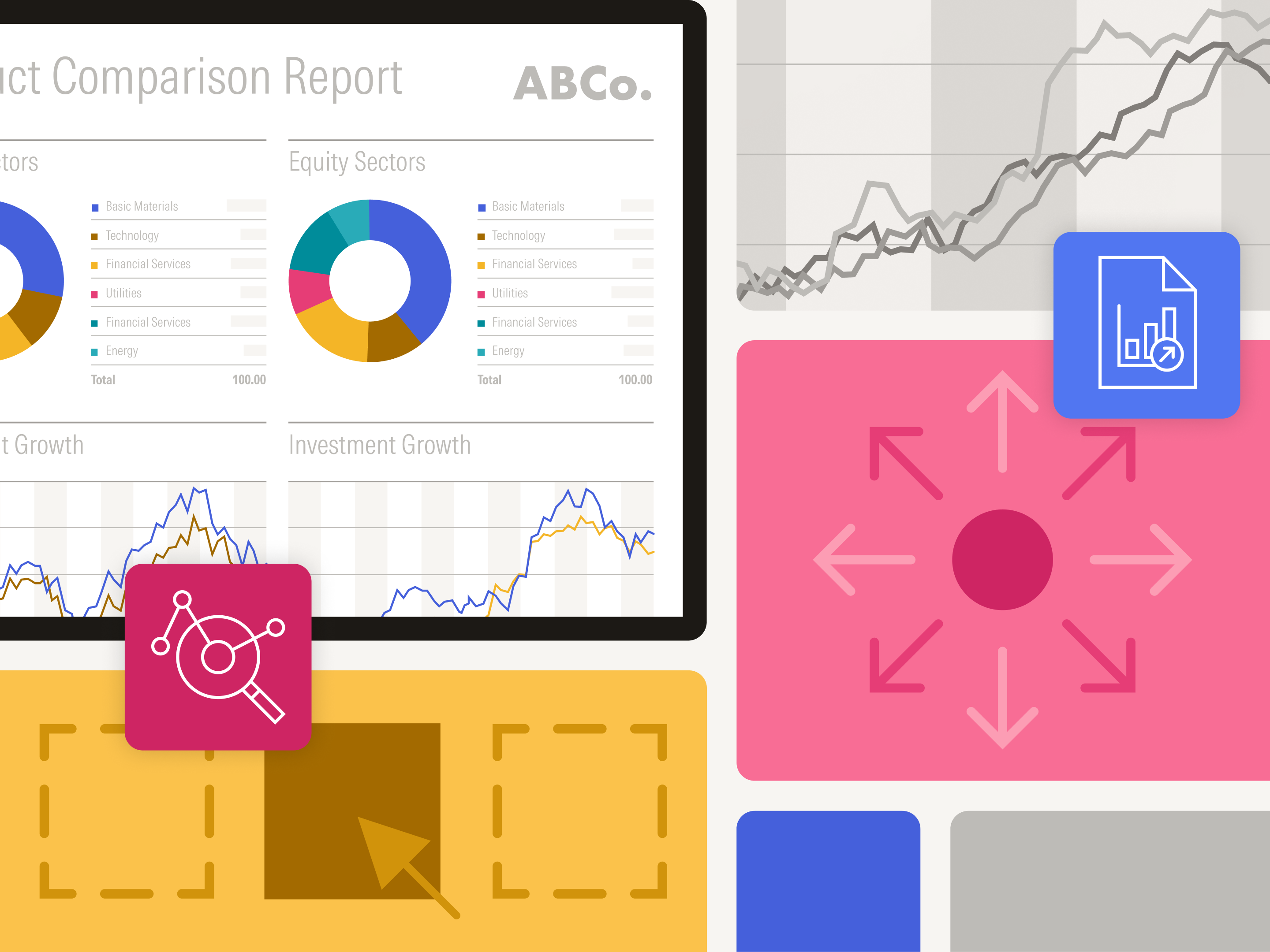
Investments are more than just numbers—they’re stories. Within Morningstar Direct’s Reporting Solutions, you can turn complex investment data into clear, custom-branded reports, product comparisons, and presentations using Morningstar's trusted data and analytics.