
5 min read
LTAF Landscape: A Growing Market, Still Finding Its Retail Footing

Key Takeaways
- LTAFs are scaling steadily, but the market remains in an early stage of development.
- Institutional investors dominate, while retail access is expanding slowly.
- Liquidity terms, fees, and platform readiness remain central considerations.
Long‑term asset funds (LTAFs) are one of the UK market’s most significant recent innovations for expanding access to private markets. Designed to hold illiquid, long‑term assets while remaining open‑ended, LTAFs sit somewhere between traditional daily‑dealing funds and closed‑end private market vehicles.
Interest in the structure has grown steadily since its launch in 2021. Assets under management are rising, new products continue to come to market, and policymakers have signaled support for broader access. At the same time, LTAFs remain complex, illiquid, and operationally demanding—factors that continue to limit adoption beyond institutional investors.
Today, there are around 25 LTAFs available in the UK, underscoring both the progress the market has made and how early it still is in its development. With Stocks & Shares ISA eligibility scheduled for April 2026, LTAFs may be approaching another inflection point. Whether that translates into broader retail adoption, however, remains an open question.
This article highlights a selection of key insights from Morningstar’s latest LTAF research. It explains how the market is evolving and what investors and advisers should understand before considering an LTAF. You can read the full LTAF Landscape here.
What Is an LTAF—and How Is It Regulated in the UK?
An LTAF is an open‑ended, evergreen fund structure authorized by the UK’s Financial Conduct Authority (FCA) and designed primarily for investment in illiquid, long‑term assets, such as private credit, infrastructure, real estate, and private equity.
The structure was introduced in 2021 with the aim of facilitating greater investment into private assets, particularly by UK pension schemes. Unlike traditional daily‑dealing funds, LTAFs incorporate structural constraints to manage liquidity risk. By regulation, at least 50% of an LTAF’s assets must be invested in unlisted securities or other long‑term assets, and redemptions are subject to a minimum 90‑day notice period.
In July 2023, the FCA reclassified LTAFs as Restricted Mass Market Investments (RMMIs). This change widened the potential investor base beyond institutional investors, allowing access via advised channels and, subject to safeguards, certain retail investors. The reclassification was an important step, but it did not fundamentally alter the long‑term, illiquid nature of the structure.
While LTAFs are sometimes compared with European Long‑Term Investment Funds (ELTIFs), they are a UK‑specific vehicle governed by a distinct regulatory regime. Differences in design, distribution, and liquidity rules mean the two structures are not interchangeable, despite overlapping objectives.
Why Investors Are Looking at LTAFs
Diversification Through Private Markets
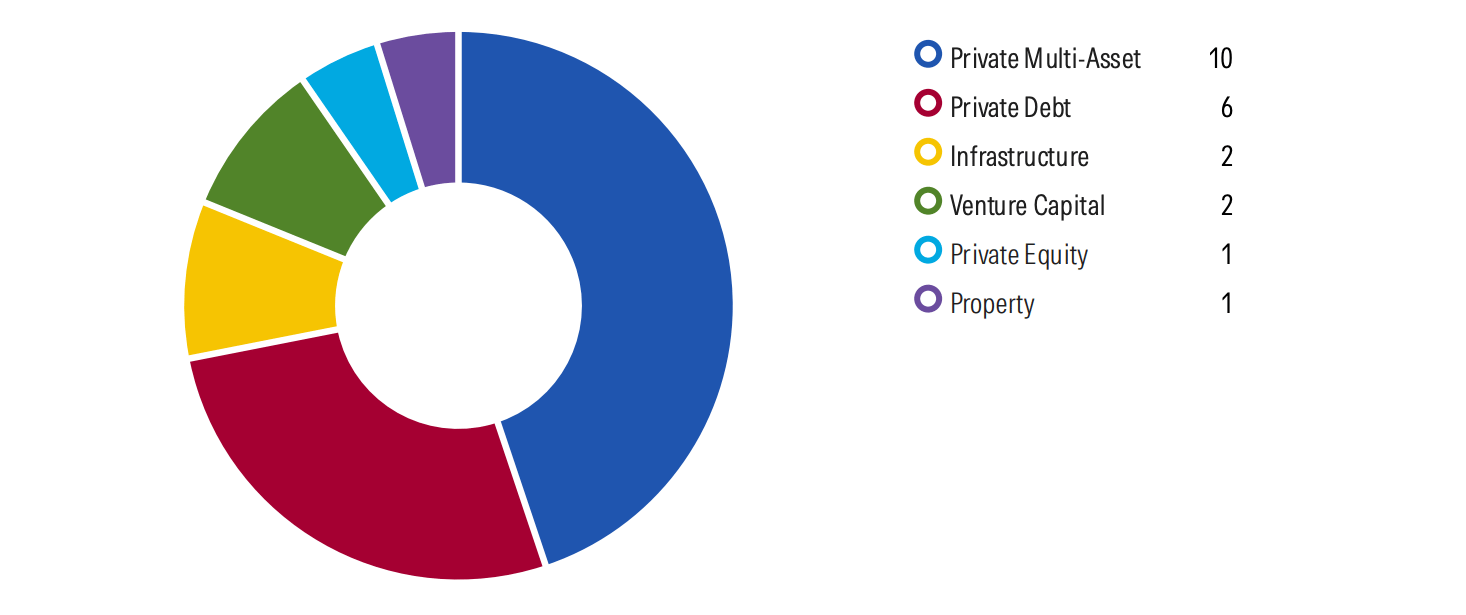
One of the primary attractions of LTAFs is access to private assets that are difficult to reach through traditional mutual funds or ETFs. The current UK LTAF universe is dominated by private multi‑asset and private debt strategies, which together account for the majority of available funds.
Private multi‑asset LTAFs typically blend exposures across private credit, infrastructure, property, and private equity, aiming to provide diversified private market exposure within a single vehicle. Private debt strategies, meanwhile, have proven particularly well‑suited to the semi‑liquid format, given their income‑generating characteristics and more predictable cash flows.
LTAF Universe: Category Breakdown (by Number of Funds)
Source: Based on information received from asset managers who responded to Morningstar's information request
Other asset classes—such as private equity, venture capital, and infrastructure‑focused strategies—are also represented, but to a lesser extent. In many cases, longer asset durations and less predictable cash flows make these strategies more challenging to accommodate within an open‑ended structure.
For long‑horizon investors, particularly defined‑contribution (DC) pension schemes, this exposure offers potential diversification benefits relative to listed equities and bonds, whose performance can become increasingly correlated during periods of market stress.
Access to Potentially Higher Long‑Term Returns
Return potential is another driver of interest, though it varies widely by strategy and risk profile. Based on manager disclosures, private debt LTAFs typically target returns in the region of SONIA plus 4% to 5%, reflecting their focus on contractual income and capital preservation.
More diversified private multi‑asset strategies often target high single‑digit net returns, while private equity and venture capital strategies pursue higher long‑term returns with significantly greater dispersion and risk.
These targets are not guarantees. Outcomes depend on manager skill, asset selection, fees, and the timing of cash flows. For investors, the key point is that LTAFs are designed to deliver returns over long time horizons, often measured in years rather than quarters.
Growth Is Real—but the Market Is Still Building Out
Measured by assets alone, the LTAF market has grown meaningfully. Total AUM across FCA‑approved LTAFs now stands at approximately GBP 7.3 billion, up from around GBP 5 billion in June 2025. Yet headline growth figures only tell part of the story.
Around GBP 3.1 billion of committed capital remains uncalled. Illiquid assets take time to source and deploy, and liquidity management constraints can slow the pace at which capital is put to work.
In addition, some LTAFs function primarily as feeder vehicles into much larger master funds. Morningstar’s research identified roughly GBP 2.4 billion in master‑fund assets accessed through LTAF feeders—assets that are not captured in LTAF AUM figures but nonetheless reflect the broader scale of these strategies.
Looking ahead, supply‑side momentum remains intact. Several asset managers indicated that additional LTAFs are seeking FCA approval and are planned for launch in 2026, suggesting that market expansion is being driven not only by inflows, but also by continued product development.
Institutional Capital Still Dominates the LTAF Ecosystem
Despite broader distribution permissions, LTAFs remain firmly institution‑led. The large majority of assets are held by institutional investors, particularly UK DC pension schemes, reflecting the structure’s original design intent.
Fund architecture reinforces this dynamic. Approximately half of all LTAFs are structured as Authorized Contractual Schemes (ACS), which are available exclusively to pension schemes and certain institutional investors. These vehicles are not accessible via retail or wealth platforms, regardless of regulatory classification.
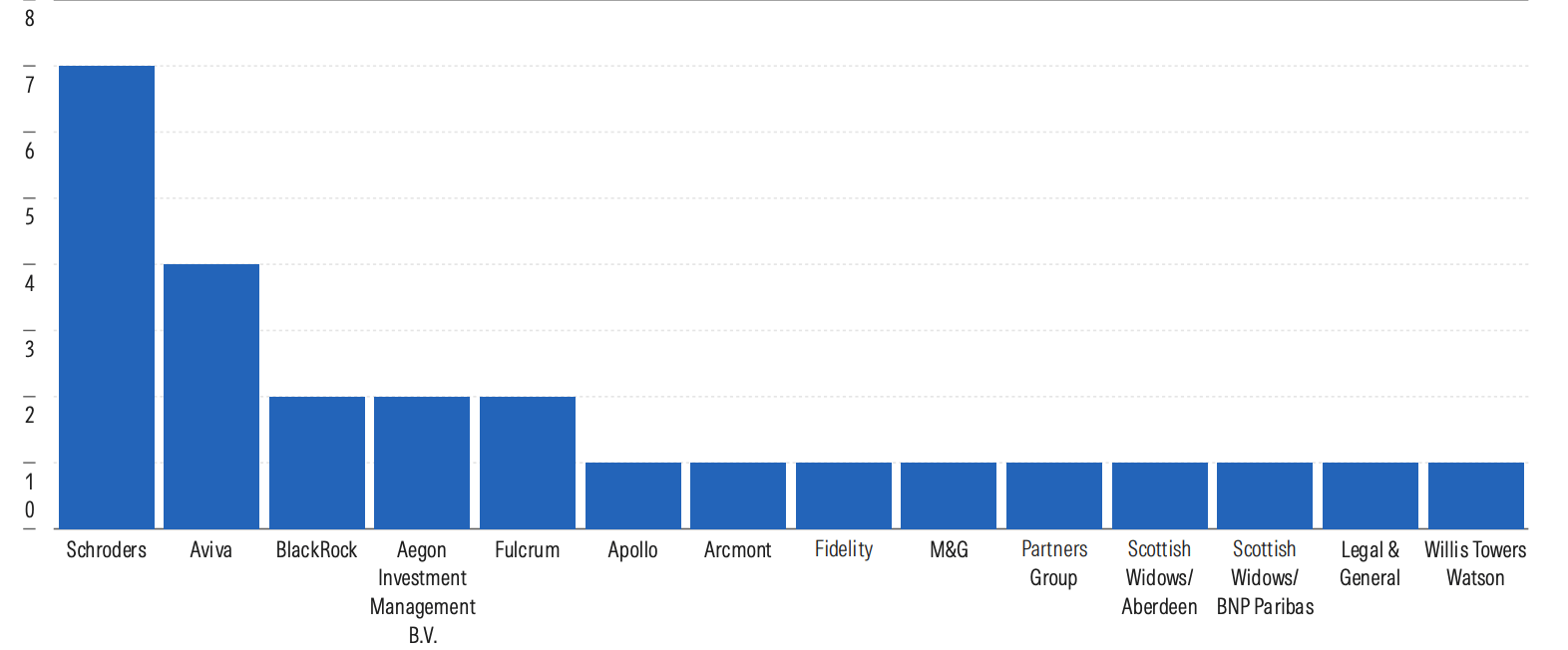
Number of LTAFs by Asset Manager
Source: FCA website, as of March 15, 2026.
For DC schemes, the appeal is clear. Long contribution horizons, relatively predictable cash flows, and limited short‑term liquidity needs make pensions natural holders of illiquid assets. Policy initiatives encouraging pension investment into private markets—such as the Mansion House reforms—have further supported institutional uptake.
Wealth interest is growing—but retail adoption remains limited
Interest from the wealth channel has increased, particularly among advisers seeking to incorporate private assets into diversified portfolios. However, true retail adoption remains limited, despite the RMMI reclassification.
Mass‑market retail distribution faces additional hurdles. Suitability assessments, liquidity constraints, and operational complexity continue to restrict broader participation.
Liquidity Remains the Defining Constraint
The term “semi‑liquid” is often used to describe LTAFs, but it can understate the practical limitations investors face. In most cases, LTAFs offer quarterly dealing, with a minimum 90‑day notice period for redemptions.
Even then, liquidity is capped. Investor‑level redemption limits are typically set at around 5% of NAV per quarter, sometimes alongside annual caps. These limits are designed to protect remaining investors but can significantly extend exit timelines.
Liquidity management goes further. Most LTAFs maintain liquidity buckets of roughly 20% of portfolio assets, though composition varies by strategy. Many funds also impose initial lock‑up periods, often around three years, particularly for equity‑heavy strategies.
In periods of stress, fund‑level gates may be activated, delaying redemptions even when notice periods have been met. For advisers and investors, the implication is clear: capital may take years, not months, to be fully returned.
Retail Access May Broaden—Slowly
The decision to allow LTAFs within Stocks & Shares ISAs from April 2026 represents a meaningful policy signal. It suggests a desire to widen access to long‑term investments beyond institutional and advised channels.
That said, ISA eligibility alone is unlikely to transform the market overnight. Platform readiness remains uneven. Around one‑third of platforms already offer LTAFs or are actively onboarding them, while nearly 60% remain in a monitoring or development phase.
Additional friction points persist. LTAFs’ classification as Restricted Mass Market Investments requires appropriateness assessments, and within pension wrappers, non‑standard asset treatment in SIPPs can increase capital requirements for operators.
As a result, infrastructure and operational capability—not only investor demand—are likely to determine the pace of retail expansion.
LTAFs Are Advancing—but They Remain a Long‑Term Allocation Tool
LTAFs have made tangible progress since their introduction. Assets are growing, institutional adoption is deepening, and regulatory support continues to evolve. Yet they remain complex vehicles, best suited to investors who can tolerate illiquidity, variability, and long investment horizons.
As access broadens gradually, education and expectation‑setting will be as important as distribution. For advisers, understanding liquidity terms, fee structures, and underlying asset risks remains critical.
Direct Advisory Suite (DAS) provides advisers with the data and insights they need to evaluate manager performance, understand semiliquid fund ratings, and construct resilient, well‑diversified portfolios that thoughtfully incorporate private market exposure.