
10 min read
Incentive Fees in Semiliquid Funds: Irregularly Disclosed, Regularly Collected
Incentive fee structures in semiliquid funds present some problems, like rarely rewarding investment skill and simply incentivizing risk-taking.

Key Takeaways
Incentive fees are often excluded from prospectus fee tables because asset managers claim they cannot predict whether the fees will be earned or not.
Private equity semiliquid funds typically charge incentive fees on unrealized gains, an investor-unfriendly practice given the lack of reliable and timely valuations in private markets.
Morningstar is developing a methodology for normalizing fees based on fee structures and gross return assumptions.
First impressions are everything when it comes to fund fees. Years of fund flow data show that when investors know what they are paying—no matter the vehicle—they tend to migrate to the lower-cost options. Semiliquid fund managers understand this behavior and often materially understate their already-high fees to attract assets. And because fee disclosure is a bit of a regulatory gray area, it’s hard for investors to make true apples-to-apples fee comparisons.
Incentive fee structures themselves could use work, beyond just improving disclosure. These fees are supposed to go to a manager for a job well done. They are a percentage of profits above a certain minimum return threshold (the “hurdle rate” or “preferred return”). The concept carries some logic for equity-centric portfolios, but it is much less defensible when it comes to income-driven strategies.
Meanwhile, semiliquid fund hurdle rates often aren't that hard to clear, making incentive fee collection a near certainty and begging the question: What is actually being incentivized? The answer, when it comes to income-driven portfolios, is risk.
This article is derived from the recently published Morningstar research report “The Cost of Incentive Fees and Semiliquid Funds.” Download the free report to get the full analysis, extended commentary, additional charts, and more.
The Problem With Nonuniform Disclosure in Semiliquid Funds
Incomprehensibly, many semiliquid funds, particularly unlisted business-development companies, do not include incentive fees in their prospectuses.
Why? Almost all of them include boilerplate language that says, “As we cannot predict whether we will meet the necessary performance targets, we have assumed no incentive fee for this chart.” Yet, plenty of private credit funds do include at least something about incentive fees in their prospectuses. Some offer an estimate based on assumed returns, while others use prior years’ realized results.
Let’s look at two real-world examples: Blue Owl Credit Income and Blackstone Private Credit. These two unlisted BDCs have the same fee structure. They charge a 1.25% management fee and a 12.5% income-based incentive fee (subject to a full catch-up) above a 5% hurdle rate.
If an investor were just to look at the two prospectuses’ fee tables, they could conclude that Blue Owl’s annual expense ratio is a lot lower after backing out borrowing costs (which Morningstar does when adjusting expense ratios). But it only appears that way because Blue Owl pleads ignorance on its ability to predict incentive fees and thus leaves them out, while Blackstone does not (it cites the prior year’s realized number). What were the actual fees incurred by both strategies in 2024? They were nearly identical on a borrowing-cost-adjusted basis, as should be expected from two funds with identical fee structures that both easily cleared their 5% hurdle rate.
The lesson is simple: Looking at prospectus fee ratios alone can lead investors astray. Blue Owl is not a singular example. Two-thirds of the two dozen or so unlisted BDC managers do not include incentive fees in their prospectuses, even though nearly all of them have identical fee structures.
Despite Highly Similar Fee Structures, Unlisted BDC Prospectus Fees Vary Significantly

Source: Morningstar Direct, SEC Filings. Expenses are based on D share classes.
The Problem With Earning Cash Bonuses on Noncash Gains
It’s not only about private credit managers. Semiliquid private equity funds have their own incentive fee warts. The biggest being charging incentive fees on unrealized gains. While not all semiliquid private equity funds charge incentive fees at the fund level, the ones that do generally collect a percentage of the fund’s net profit each quarter, often with no hurdle rate and regardless of whether the gains are realized (that is, actual cash was generated on a sale) or unrealized (simple valuation markups). These incentive fee structures are especially unfriendly to investors in secondary-focused funds, which take advantage of an accounting quirk to book one-day gains without any actual cash generation.
The primary problem with charging fees on unrealized gains is that the gains may turn into realized losses in the future. Collecting fees on potentially inflated valuations, especially since private market valuations are known to lag public ones, and then selling the asset for a loss is obviously a poor outcome for investors. Investors cannot recoup prior fees following a future loss. There are some investor protections in place, though. The incentive fees are typically subject to high-water marks, meaning the fund must surpass its previous highs before collecting new incentive fees.
Still, these fees can be meaningful. Below shows Vanguard S&P 500 ETF’s trailing 20-year returns and what it would have returned if it collected 10% of profits each quarter, subject to a high-water mark. The incentive fee would have resulted in a nearly 20% reduction in ending wealth for the investor, as the actual exchange-traded fund gained 10.89% annualized, which would have been pared to 9.78% if it charged the incentive fee. For context, that is the difference between landing in the top 15th percentile of all surviving large-blend Morningstar Category share classes and the bottom half of the category. To match the S&P 500 ETF's net-of-incentive fees, a fund would have needed to generate a 12.12% annualized gross return, or 1.2% of excess return in addition to its management fees and other fees.
Equity Incentive Fees on Unrealized Gains Can Eat Into Performance Significantly
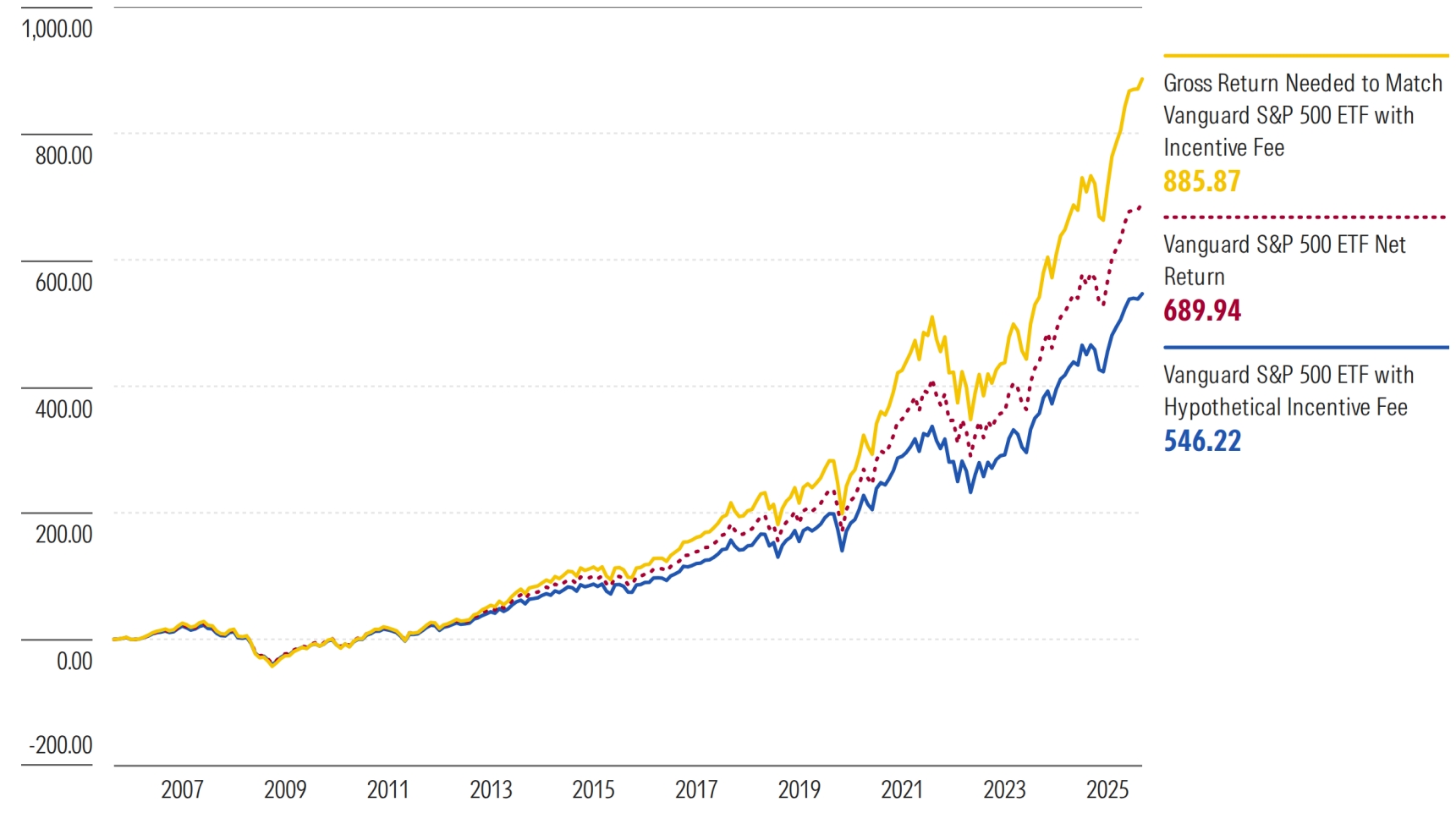
Source: Morningstar Direct, author's calculations. The incentive fee is 10% of quarterly profits in excess of a loss recovery account, which represents to-date cumulative net losses, if any.
How Morningstar Would Improve Incentive Fees in Semiliquid Funds
Morningstar researchers and analysts have a few ideas for normalizing fees based on fee structures and gross return assumptions. They begin with creating better alignment. In a perfectly investor-friendly world, incentive fees should probably be scrapped altogether or at least given a new name to reflect that these are rarely bonuses for a job well done. It would be more honest to charge a higher management fee than to disguise a separate ongoing fee as an "incentive."
On the equity side, collecting incentive fees only on realized gains would be a better structure, along with adding some form of a hurdle rate to truly make it an incentive fee. In fact, traditional private equity drawdown funds almost always have those features. Given the lack of clear, reliable valuations in private markets, we do not think collecting incentive fees on unrealized gains is appropriate.
There’s a lot more to unpack here. Download the free report “The Cost of Incentive Fees and Semiliquid Funds” to learn more.