4 min read
6 Asset Management Marketing Trends to Watch in 2026
Exchange-traded funds, semiliquid funds, and model portfolios are reshaping the investment landscape. As a marketing leader, what steps do you need to take in 2026 to drive pipeline, marketing influence, and retention?

ETFs and active ETFs, model portfolios, and semiliquid funds are no longer niche innovations. They’re redefining how advisors build portfolios and how investors access markets. Leaders across marketing, sales, and distribution must translate these trends into measurable growth across pipeline, retention, and return on marketing investment.
These are six of the key asset management marketing trends you need to know to secure a competitive edge in 2026.
The Rise of Fund Wrapper-Driven Selection
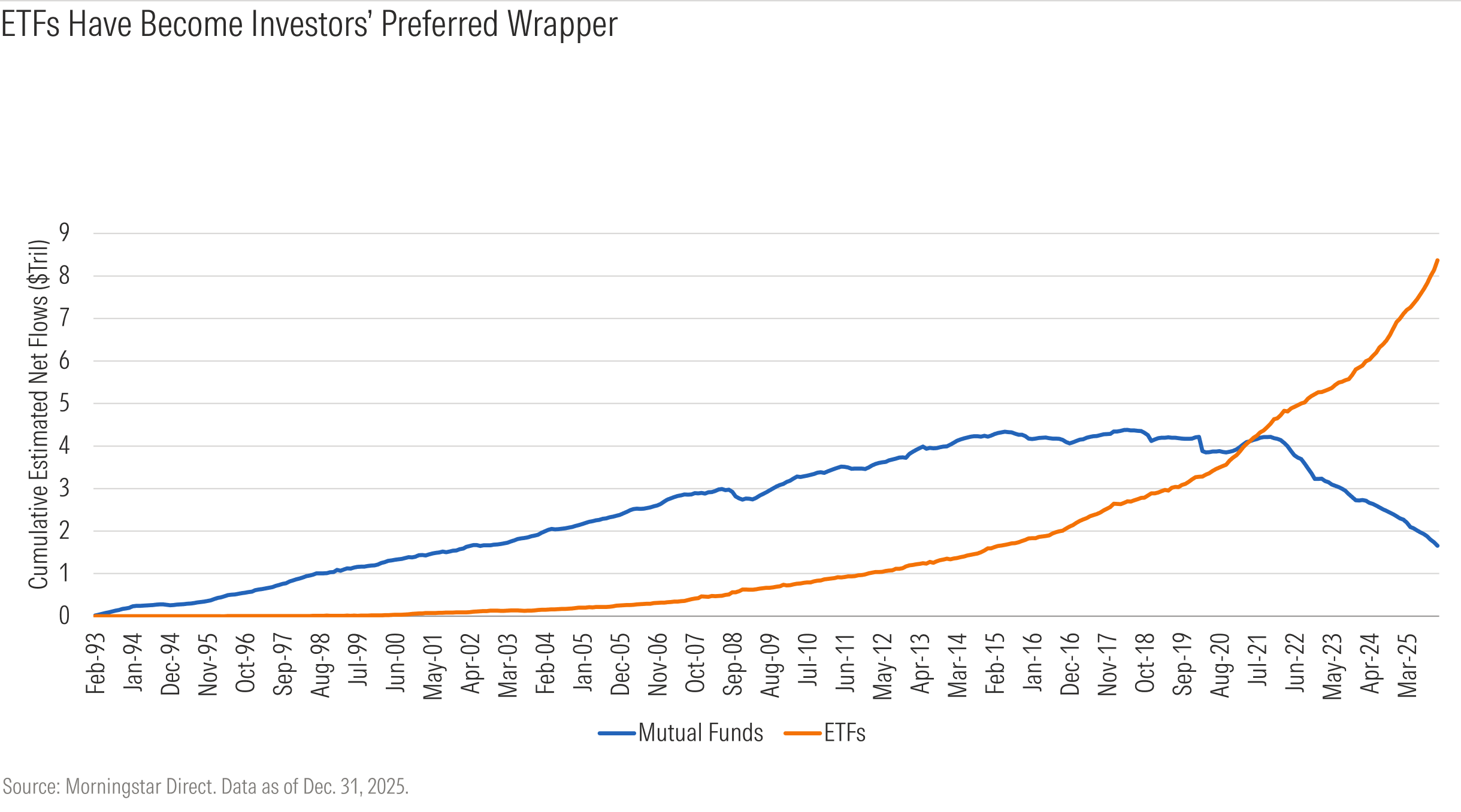
As mutual fund dominance erodes, ETFs have become investors’ preferred wrappers. The rapid growth of ETFs reflects their liquidity, tax efficiency, and transparency, which align with modern buyer expectations. At the same time, collective investment trusts are capturing share in retirement channels, particularly among plan sponsors and consultants focused on cost and operational efficiency.
The takeaway: Investment vehicles now form a critical part of your value proposition.
Reframe messaging that relies on strategy or performance to highlight how you deliver, access, and integrate that strategy into portfolios. Firms that fail to modernize their vehicle narrative will end up filtered out before performance enters the conversation.
Active Investing Redefined Around Outcomes, Not Process
Active management isn’t disappearing. It’s being repackaged. Active ETFs now dominate new ETF launches, and investor adoption continues to rise. But “active” spans a wide spectrum today. The term covers systematic equity and factor-based approaches to options income and defined outcome strategies.
This evolution raises the bar for marketing and sales leaders. Broad claims about skill or alpha no longer suffice. Investors want clarity on outcomes: income generation, downside buffers, tax efficiency, or portfolio completion.
To capture winning flows, you must articulate the role each strategy plays in a portfolio with transparent investment data and practical use cases.

Alternatives Go Mainstream(ish)
Investor demand for alternatives is expanding, but with a clear preference for accessibility. Advisors are seeking income, safety, and diversification through new fund structures. They're flocking to options-based strategies, defined outcome funds, and semiliquid vehicles such as tender-offer or interval funds.
These products are more complex, which means education must sit at the heart of your strategy. Clear explanations of liquidity terms, risk profiles, and portfolio fit are essential. That's not only for adoption, but to manage expectations and protect long-term client relationships.

Model Portfolios as the New Distribution
Model portfolios now function as a powerful distribution channel in their own right. Advisors rely on models to save time, standardize portfolios, and scale advice. Yet, they still demand flexibility through custom or semi-custom approaches. As a result, a sharp model portfolios distribution strategy means you’re no longer just marketing funds—you’re marketing comprehensive portfolio solutions.
Models allow you to craft repeatable stories around asset allocation, risk management, and outcomes. They also enable co-branded content, proposal tools, and client-ready visuals that help advisors adopt and stick with your firm’s solutions. In many cases, models can act as the primary interface between your brand and the end investor.

Operational Agility: Measurement, ROMI, and Speed
Consolidation and fee pressure continue to compress industry margins. Naturally, that brings scrutiny to your marketing effectiveness. In this environment, marketing leaders are shifting toward clearer attribution and faster execution. That means you must align your go-to-market motions closely with investment vehicle metrics, and measurement must evolve accordingly.
Traditional lead counts are no longer enough. Instead, focus on vehicle-level funnels, advisor engagement metrics, and buying signals such as model adoption or shortlist inclusion.
Operationally, modular content and reusable fact packs can help your team respond quickly when product offerings or market conditions shift.
AI Integration is Essential to Modern Operations
Artificial intelligence is fundamentally reshaping how all industries operate. For financial services, generative AI capabilities and machine learning processes are altering everything from investment strategy formulation to company analysis and reporting. You can apply AI in asset management marketing to build the personalized experiences investors crave. The key is knowing how and when to use these tools.
Marketing and sales leaders must build processes that harness AI‘s speed while retaining human intelligence in the loop. Your marketing organization can work smarter and faster by creating efficient workflows and scaling your personalization efforts. But always consider when and where the human touch is still needed.
The Bottom Line for Marketers
The firms that will outperform in 2026 aren‘t necessarily those with the largest product lineups. Instead, it will be those who translate shifting asset management market trends into clarity and confidence for their buyers. ETFs, models, and semiliquid alternatives are reshaping demand. Your role is to distill this complexity into simple choices, compelling stories, and measurable growth.
Morningstar Direct is here to help. The application gives asset managers the much-needed tools to construct diversified portfolios, analyze trends with the latest fund flow data, and build sustainable products that line up with client values. And it's all backed by our trusted investment data.