
4 min read
Semiliquid Funds in APAC: Access, Liquidity, and Potential Trade-Offs

Key Takeaways
- Semiliquid fund structures are evolving quickly—but innovation often brings new, unfamiliar risks.
- Private assets for individual investors remain relatively untested, particularly through prolonged market stress.
- Semiliquid funds tend to charge higher fees than public asset funds and may include multilayered fee structures, incentive fees, or high transaction costs.
Private assets have long been a staple of institutional portfolios. Today, they’re increasingly finding their way into individual investor portfolios as well—both sophisticated and, in some markets, retail. Much of this shift is framed as “democratization”: the idea that private credit, private equity, and other alternatives are no longer reserved for large institutions.
In practice, the story is more nuanced.
Across Asia-Pacific, non-institutional semiliquid vehicles have grown rapidly, but the landscape is uneven. Each market has its own regulatory history, distribution model, and investor protections—and many frameworks are still evolving. Regulators and distributors alike are often taking an iterative approach, adjusting as risks and frictions become clearer.
At the heart of semiliquid investing is a series of trade-offs:
- Broader access versus more complex and less familiar risks
- Investor liquidity expectations versus inherently illiquid assets
- Manager economics versus fee transparency and fairness
Understanding where and how different vehicles strike those balances is critical to assess suitability and risk.
Understanding the Structures
While US investors may already be familiar with semiliquid fund structures, the APAC story is far from uniform. Markets are at very different stages of development, and unlike the US, there isn’t always a standardized menu of structures.
Below is a snapshot of commonly used semiliquid vehicles across APAC:
- Evergreen Funds: Open-ended funds investing primarily in illiquid assets, with periodic liquidity windows. They sit between traditional mutual funds (high liquidity) and closed-end private vehicles (very limited or no liquidity).
- Master-Feeder Funds: Multiple feeder funds—differentiated by domicile, tax treatment, or fee arrangements—invest into a central master fund, often domiciled in tax-efficient jurisdictions such as the Cayman Islands. Investors typically access the feeder, while large institutions may invest directly in the master vehicle.
- Crossover Funds: Not a discrete structure, but a type of strategy. These funds invest mainly in private assets (often private equity) while maintaining a sleeve of public securities to help meet redemption needs.
- SICAV Part II Funds: Luxembourg-domiciled, open-ended vehicles with broad flexibility across asset classes. While access in Hong Kong and Singapore is limited to sophisticated investors, these funds can be offered to retail investors elsewhere.
- Listed Investment Vehicles: Includes listed investment trusts and listed investment companies. These closed-end vehicles trade on exchanges, offering daily liquidity to investors—but prices are driven by supply and demand and can deviate materially from NAV.
- Open-Ended Category III Alternative Investment Funds (AIFs - India): High-risk vehicles designed for sophisticated investors, with high minimum investments, limited liquidity windows, and significant scope for leverage.
- Specialized Investment Funds (SIFs - India): Introduced in 2025, SIFs aim to extend semiliquid access to mass-affluent investors. Minimums are lower than AIFs, and tax efficiency is a core design feature—though entry barriers remain far above traditional mutual funds.
Common Semiliquid Fund Structures in the Asia-Pacific Region
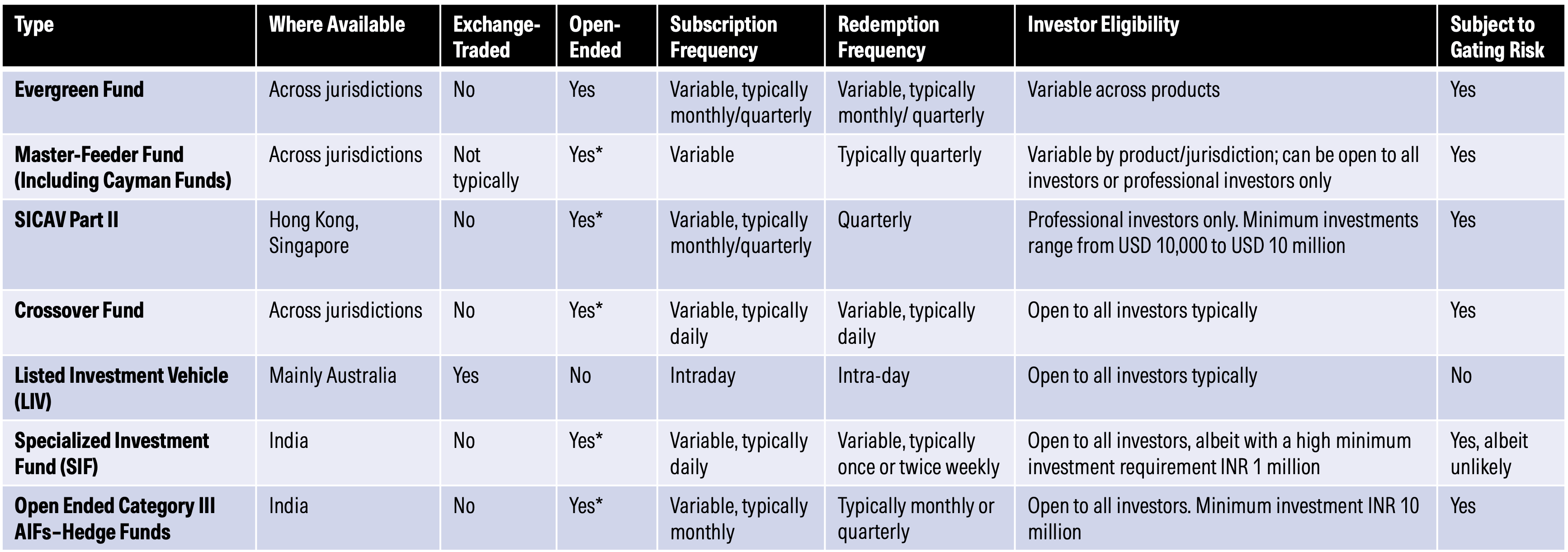
* While typically open-ended, these semiliquid structure types can also be closed-ended.
Who Can Invest?
Hong Kong and Singapore
Japan
India
Australia
Liquidity Features and Their Limits
Common tools include holding cash or liquid assets, netting subscriptions against redemptions, relying on loan repayments, or maintaining public market sleeves. Some managers may sell assets or arrange credit facilities to fund redemptions—though both approaches introduce their own risks and costs.
Many vehicles limit liquidity through:
- Periodic redemption windows with advance notice
- Lock-up periods, sometimes lasting several years
- Redemption caps, often implemented via repurchase agreements
If demand exceeds limits, redemptions are processed pro-rata—meaning investors may not get out in full when they want.
India’s new SIF regime allows wide flexibility on redemption frequency, from daily through annual. Early market practice suggests daily or weekly liquidity is emerging—placing significant pressure on day-to-day liquidity management.
When liquidity tools fall short, there’s gating. Gating allows managers to halt redemptions altogether once requests reach a specified threshold—sometimes as low as 5% of NAV. While still relatively rare, gating risk is important to understand, especially given the limited stress-testing history of many semiliquid vehicles.
At the other end of the spectrum are listed closed-end structures such as LITs. Gaining traction in Australia for private credit exposure, these vehicles offer continuous market liquidity without requiring managers to meet redemptions. They can’t be gated—but investors bear market pricing risk, including discounts or premiums to NAV.
How Assets Are Valued
Valuation practices vary by jurisdiction and structure. India is the most prescriptive, requiring daily NAVs for SIFs and monthly for AIFs. Elsewhere, NAV frequency generally aligns with liquidity terms.
Most semiliquid funds rely on mark-to-model valuations, using forecasts, assumptions, and periodic reviews—often monthly or quarterly. Independent valuation agents may be involved, though some firms retain valuations in-house.
In markets like India, transparency appears higher—largely because early SIF portfolios skew toward listed assets, where pricing is more objective.
Leverage: Performance Tool or Risk Multiplier?
Leverage is common in semiliquid funds, but limits and usage vary widely. It may be used to enhance returns, ease working capital needs, or help facilitate redemptions—but it increases risk and complexity.
Fee structures can further complicate the picture. In some cases, management fees are charged on gross assets rather than net, meaning higher leverage can directly boost manager revenue.
For advisors, close reading of disclosure documents is essential—leverage terms aren’t always obvious.
Breaking Down the Full Cost
Unlike traditional open-ended vehicles for liquid asset classes, semiliquid fee structures tend to be more expensive. Other than base management fees, investors may encounter:
- Incentive fees or carried interest
- High-water marks and clawbacks
- Upfront and ongoing fixed fees
- Withdrawal or redemption penalties
Master-feeder structures warrant particular caution, as multilayered fees can materially erode returns once incentive and distribution costs are included.